

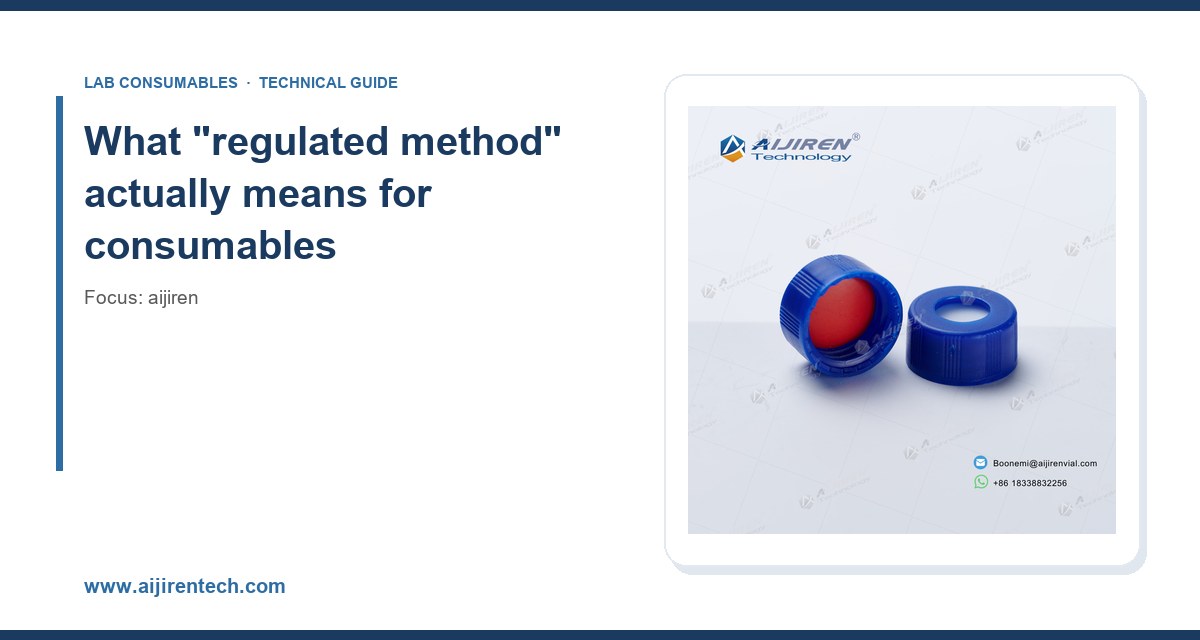
I have sat through three different method audits where the failure traced back to a vial, not a column. In one case, a 2 mL autosampler vial with a 9 mm screw thread and a PTFE/silicone septum was leaking just enough to shift internal standard response by 6% over a 40-injection run. The method was EPA 8260, the instrument was fine, and the analyst was experienced. The problem was a cap that had been torqued by hand to roughly 1.2 N·m instead of the 1.5 to 1.7 N·m the closure was designed for. That is the kind of detail regulated methods care about, and it is the kind of detail that gets missed when procurement buys consumables as commodities. This article is about how aijiren consumables fit into regulated analytical methods under EPA, ISO, and AOAC frameworks, and what you need to control to keep a validated method in a state of control.
A regulated method is a written procedure with a fixed set of performance requirements that someone else will check. EPA SW-846 methods, ISO 17025-accredited lab procedures, and AOAC Official Methods all share a common trait: they specify or imply acceptance criteria for precision, accuracy, detection limits, and sometimes sampling handling. The consumable is not usually named in the method text. What is named is the container, the injection volume, the internal standard, the preservation, and the holding time. Every one of those touches a vial, a cap, a septum, or a syringe filter.
Under U.S. EPA SW-846 test methods for waste and materials, the consumable requirements are mostly buried in the sample collection and preservation sections plus the quality control acceptance criteria. Method 8260D, for example, requires that volatile organic samples be collected in 40 mL vials with PTFE-lined septa, with zero headspace, and analyzed within 14 days. The method does not tell you which septum durometer to buy. It tells you the result has to hold. If your septum off-gasses or adsorbs, you fail the QC, and the method does not care why.
ISO methods (ISO 17025 for lab competence, ISO 11843 for detection capability) put the burden on the lab to demonstrate that consumables do not degrade method performance. AOAC Official Methods add collaborative study data, which means the consumable behavior in your lab must be comparable to the behavior in the study. That is a higher bar than most procurement teams realize. When you buy a vial, you are buying into a reproducibility assumption.
The three failure modes I see most
First, adsorption. Basic compounds stick to untreated glass and to some silicone septa. A 10 ppb amine standard in a plain borosilicate vial can lose 20 to 40% of signal in 24 hours at 4 °C. Second, leaching. Low-quality septa and cap liners release plasticizers and sulfur compounds that show up as ghost peaks in GC-MS. Third, dimensional drift. A vial with a neck OD outside the GPI 9 mm tolerance will not seat consistently, and the autosampler needle either cores the septum or bends. All three are consumable problems that present as instrument or method problems.
EPA SW-846: the consumable requirements you have to meet
SW-846 is a guidance compendium, not a single regulation, but it is the reference most US environmental labs are audited against. The methods that matter most for consumables are the volatile organics series (8260, 5030, 5035), the semivolatile series (8270, 3510, 3540), and the metals series (3010, 3050). Each has consumable implications that are specific and testable.
VOC methods (8260, 5030, 5035)
The 40 mL VOC vial is the workhorse. The method expects a borosilicate glass vial, a 24 mm screw thread or a crimp closure, and a PTFE-faced silicone septum. The critical numbers:
- Volume: 40 mL nominal, filled to zero headspace (meniscus at the rim). A 1 to 2 mm bubble is tolerated by most labs; anything larger is a re-collection.
- Septum: PTFE-faced silicone, 3.0 mm thick, 22 mm diameter for 24 mm closures. The PTFE face goes toward the sample. Silicone side toward the needle.
- Closure torque: 1.5 to 1.7 N·m for 24 mm screw caps. Hand-tight is not a specification.
- Holding time: 14 days at 4 °C for 8260, with zero headspace. The septum must not permit measurable loss over that window.
- Puncture count: one puncture per vial, period. A second puncture on a 24 mm silicone septum at 3.0 mm thickness creates a tear that leaks within hours.
I have seen labs try to reuse VOC vials after rinsing. Do not. The septum deforms on the first puncture, and the reseal is not gas-tight. The cost of a vial is a few cents; the cost of a re-collection and a rejected batch is a day of field time.
Semivolatile methods (8270, 3510, 3540)
Semivolatile extraction uses larger containers: 1 L amber glass bottles for aqueous samples, 250 mL jars for solids. The consumable requirements here are about adsorption and contamination. Amber glass protects photosensitive analytes. The cap liner must be PTFE-faced, not foil or plain silicone. Foil liners corrode in contact with acidic preservatives (HCl, H2SO4) and release metal ions that interfere with the metals analysis downstream. I have seen a batch of 8270 extracts fail on lead because the bottle cap had an aluminum foil liner that dissolved in a 2% HCl preservative.
Metals methods (3010, 3050)
Digestion vessels and sample cups matter here. Trace metals work at the ppb level requires that the container not leach. Borosilicate glass is acceptable for most elements; polyethylene and PTFE are better for trace sodium, potassium, and boron. The autosampler cups for ICP-MS should be virgin polypropylene, not regrind. Regrind cups can carry residual metals from prior manufacturing runs. I specify virgin PP cups with a documented leach test for the analyte list, and I ask for the certificate.
ISO 17025 and the consumable qualification file
ISO 17025 does not name consumables, but clause 6.6 (externally provided products and services) requires that you evaluate and approve suppliers and that the consumable does not adversely affect the validity of results. In practice, this means you need a consumable qualification file. The file should contain:
- Supplier qualification record: who the supplier is, what quality system they run (ISO 9001 is the floor), and the last audit date.
- Certificate of analysis or conformance: lot-specific, with the tested parameters (dimensions, septum durometer, extractables).
- In-house verification: a documented check that the consumable does not shift a system suitability parameter. For a vial, that is a blank injection and a standard injection on the same instrument, compared against the historical mean.
- Change control: a record of any supplier change (material, mold, factory) and the re-verification that followed.
The verification step is where most labs fall short. They buy a case of vials, run their samples, and never check whether the new lot behaves like the old one. A simple check is a 6-injection blank run and a 6-injection standard run at the method’s mid-point concentration, with the RSD% compared against the method acceptance criterion (usually 15% for 8260, 20% for 8270). If the new lot pushes RSD% from 4% to 11%, you have a problem, even though the method still passes.
What to put in the supplier questionnaire
Ask for the septum durometer (Shore A, typically 45 to 55 for autosampler septa), the PTFE face thickness (0.1 to 0.2 mm is standard), the glass neck tolerance (GPI 9 mm is 9.0 ± 0.2 mm), and the extractables profile in the relevant solvent. A supplier who cannot produce these numbers is not a regulated-method supplier. This is the difference between a commodity vial and a qualified one.
AOAC Official Methods: reproducibility and the consumable
AOAC methods are validated through collaborative study, which means multiple labs running the same procedure on the same materials. The consumable is part of the procedure whether the method text says so or not. If your lab uses a different vial geometry or septum chemistry than the collaborative study labs, your reproducibility claim is weaker than the method’s.
For AOAC methods in food and feed analysis, the consumables that matter most are the extraction vessels, the filter syringes, and the autosampler vials. A 0.45 µm PTFE syringe filter is not the same as a 0.22 µm nylon filter for a fatty acid method. The nylon adsorbs fatty acids; the PTFE does not. I have seen a lipid method lose 8% recovery because the analyst grabbed the wrong filter box. The method passed on the standard, failed on the sample, and the filter was the cause.
Filter selection by method type
Here is a decision table I use. It is not exhaustive, but it covers the common cases:
- Aqueous, polar analytes: 0.45 µm nylon or PES. Low adsorption, high flow. Replace if backpressure exceeds 30 psi.
- Organic solvents, non-polar analytes: 0.45 µm PTFE. Chemically inert, no adsorption of hydrocarbons. Do not use for aqueous samples (PTFE is hydrophobic and will not wet).
- Trace metals: 0.45 µm PTFE or polypropylene, acid-washed. Nylon can leach amines that interfere with some ICP-MS methods.
- High-particulate digests: 0.45 µm glass fiber prefilter stacked with 0.22 µm PTFE. The prefilter extends the membrane life and prevents the “filter plugged at 2 mL” failure.
Selection criteria with numbers
When I evaluate a consumable for a regulated method, I run it against a fixed checklist. The numbers below are the ones I have found hold up across EPA, ISO, and AOAC work.
Vials
- Glass: Type I borosilicate (USP Type I), hydrolytic class 1. Not soda-lime. Soda-lime leaches sodium and calcium and shifts pH over time.
- Neck: GPI 9 mm for autosampler vials, 9.0 ± 0.2 mm OD. GPI 13 mm for 4 mL vials, 13.0 ± 0.3 mm. GPI 24 mm for 40 mL VOC vials, 24.0 ± 0.5 mm.
- Volume: 2 mL for autosampler, 1.5 mL usable. 40 mL for VOC, filled to zero headspace.
- Temperature rating: -80 °C to +120 °C for borosilicate. Do not autoclave above 121 °C for repeated cycles; the glass survives but the septum does not.
- Puncture count: one per septum for 9 mm and 24 mm. Two-puncture septa exist for some autosamplers, but I do not recommend them for regulated methods because the second puncture enlarges the hole and the reseal is not reliable.
Caps and septa
- Septum material: PTFE-faced silicone for GC and HPLC. PTFE-faced rubber for headspace. Pure silicone for short-run methods where adsorption is not a concern.
- Durometer: 45 to 55 Shore A. Softer septa seal better but core more easily. Harder septa resist coring but leak at low torque.
- Thickness: 3.0 mm for 24 mm closures, 1.0 mm for 9 mm closures. The 9 mm septum is thinner because the autosampler needle travel is shorter.
- Torque: 1.5 to 1.7 N·m for 24 mm screw caps, 0.8 to 1.0 N·m for 9 mm screw caps, 0.6 to 0.8 N·m for 13 mm. Crimp caps are set by the crimper, not by torque; check the crimper setting with a go/no-go gauge every 200 crimps.
Syringe filters
- Pore size: 0.45 µm for most methods, 0.22 µm for sterile or particulate-sensitive work.
- Membrane: PTFE for organic, nylon for aqueous, PES for high-throughput aqueous, glass fiber for prefiltration.
- Housing: polypropylene, virgin. Avoid regrind housing for trace metals.
- Hold-up volume: under 100 µL for 13 mm filters, under 200 µL for 25 mm. High hold-up volume wastes sample and can bias small-volume methods.
Operational precautions that keep a method in control
Consumables are only half the story. The other half is how you handle them. These are the practices I enforce in my own lab and recommend to clients.
Storage and handling
Septum lots absorb solvent vapors from the storage room. A case of vials stored next to a solvent cabinet will show ghost peaks in GC-MS for weeks. Store vials and caps in a clean, solvent-free area, in the original sealed bags, and use them within the manufacturer’s shelf life (typically 3 to 5 years for unopened glass, 2 years for septa). Once a bag is opened, use it within 30 days for regulated work. I have seen a lab chase a “column contamination” problem for a week before finding that the vial bag had been open for six months next to a bottle of toluene.
Torque control
Hand-tight is not a torque specification. Buy a torque screwdriver with a 0.5 to 2.0 N·m range and a calibration certificate. Check it every six months. Train every analyst who caps a VOC vial. The difference between 1.2 N·m and 1.6 N·m is the difference between a leaking septum and a sealed vial, and you cannot feel it by hand.
Autosampler needle care
A dull needle cores the septum and drops a plug of silicone into the vial. The plug shows up as a ghost peak or a blocked needle. Replace needles every 500 to 1000 injections depending on the septum durometer. Softer septa wear needles faster. If you see septum coring in your chromatograms, check the needle first, then the septum durometer, then the torque.
Troubleshooting checklist
When a regulated method drifts, work through this list in order. It is ordered by frequency, not by severity.
- Internal standard response down more than 20%: check vial septum for leaks (torque, puncture count), then check the syringe for a partial clog, then check the inlet liner.
- Ghost peaks in GC-MS: run a blank vial from a fresh, sealed bag. If the peaks disappear, the old bag was contaminated. If they persist, check the septum lot and the inlet liner.
- RSD% above method criterion: check autosampler vial fill volume (should be 1.0 to 1.5 mL for a 2 mL vial), check for bubbles, check the septum for coring.
- Recovery low for basic analytes: check vial glass type (soda-lime adsorbs amines), check septum (silicone adsorbs), consider silanized glass or a different septum.
- Recovery low for hydrophobic analytes: check filter membrane (nylon adsorbs), check vial (glass is fine, but a plastic vial can adsorb).
- Metal contamination in blanks: check cap liner (foil corrodes), check filter housing (regrind leaches), check vial glass (soda-lime leaches sodium and calcium).
- Holding time failures: check septum seal over the full holding window (14 days for 8260), check storage temperature (4 °C ± 2 °C), check headspace (zero for VOC).
Where aijiren consumables fit
I have specified aijiren consumables on several regulated projects because the documentation is there and the dimensional tolerances hold. The 2 mL autosampler vials are Type I borosilicate with a GPI 9 mm neck at 9.0 ± 0.2 mm, which is what the autosampler manufacturers design to. The 40 mL VOC vials are 24 mm GPI with PTFE-faced silicone septa at 3.0 mm, and the caps torque to 1.5 to 1.7 N·m without stripping. The certificate of conformance includes the lot-specific dimensions and the septum durometer, which is what an ISO 17025 audit will ask for.
For labs running EPA 8260, the aijiren 40 mL VOC vial with the PTFE/silicone septum is the one I recommend, provided you torque it with a calibrated driver and use it once. For semivolatile work, the 1 L amber bottle with a PTFE-faced liner is the right choice, and I would avoid the foil-lined version for acidic preservatives. For autosampler work, the 2 mL vial with a 9 mm screw cap and a 1.0 mm PTFE/silicone septum is the standard, and it will survive a 100-injection run without coring if the needle is sharp.
You can see the full aijiren range at Aijiren at aijirentech.com. For vial and cap combinations specifically, Vials With Caps at vialswithcaps.com lists the GPI sizes and septum options side by side, which saves a phone call. For bulk procurement and lot traceability, Vial Supplier at vialsupplier.com is the channel I point clients to when they need a certificate of conformance with every shipment. And for the chromatography side of the method (columns, liners, filters), Lab Chromatography at labchromatography.com covers the consumables that sit alongside the vial in the same method.
Cross-referencing with instrument vendor specs
Every autosampler has a vial specification. Agilent’s autosampler documentation specifies the vial dimensions and septum thickness for each model, and the Agilent chromatography consumables and columns pages list the compatible vial and cap part numbers. Thermo Fisher’s chromatography and sample handling documentation does the same for its instruments. Cross-reference your aijiren part number against the instrument vendor’s specification before you qualify a lot. If the dimensions match, the qualification is straightforward. If they do not, you have found the problem before the audit does. Restek’s technical resources for chromatography are also useful for the septum and liner selection side of the method, particularly for the GC inlet configuration.
Decision checklist: qualifying a consumable lot
Use this as a gate before a new lot enters regulated work. Each line is a pass/fail.
- Certificate of conformance present: lot-specific, with dimensions and septum durometer. Pass if all parameters are within the tolerances above.
- Dimensional check: neck OD within ±0.2 mm (9 mm), ±0.3 mm (13 mm), ±0.5 mm (24 mm). Pass if three random vials from the lot measure in tolerance.
- Septum durometer: 45 to 55 Shore A. Pass if the certificate is in range and a spot check with a durometer agrees within ±3.
- Blank injection: 6 injections of a fresh vial with method diluent. Pass if no peak exceeds the method’s reporting limit and RSD% is under 10%.
- Standard injection: 6 injections at the method mid-point. Pass if RSD% is under the method criterion (15% for 8260, 20% for 8270) and recovery is 85 to 115%.
- Torque check: cap three vials at the specified torque and check for leaks by inversion in a dye solution for 1 minute. Pass if no dye enters.
- Puncture check: puncture one vial 10 times with the autosampler needle and inspect the septum under a loupe. Pass if no coring and no tear.
If any line fails, reject the lot. Do not “use it for non-regulated work” and hope it does not migrate into the regulated workflow. It will. I have seen it happen twice.
Takeaway
Regulated methods under EPA, ISO, and AOAC do not usually name the consumable, but they specify the result, and the consumable is part of the result. The numbers that matter are concrete: GPI 9 mm at 9.0 ± 0.2 mm, 24 mm caps at 1.5 to 1.7 N·m, 3.0 mm PTFE/silicone septa at 45 to 55 Shore A, one puncture per vial, zero headspace for VOC, 14-day holding time. Get those right, document the lot with a certificate of conformance, run a six-injection verification before the lot enters the workflow, and the consumable stops being a variable. Get them wrong, and you will spend a week chasing a column problem that was never a column problem.
References & further reading
Related resources from our lab consumables network:
- Aijiren at aijirentech.com
- Vials With Caps at vialswithcaps.com
- Vial Supplier at vialsupplier.com
- Lab Chromatography at labchromatography.com
External references and standards: