

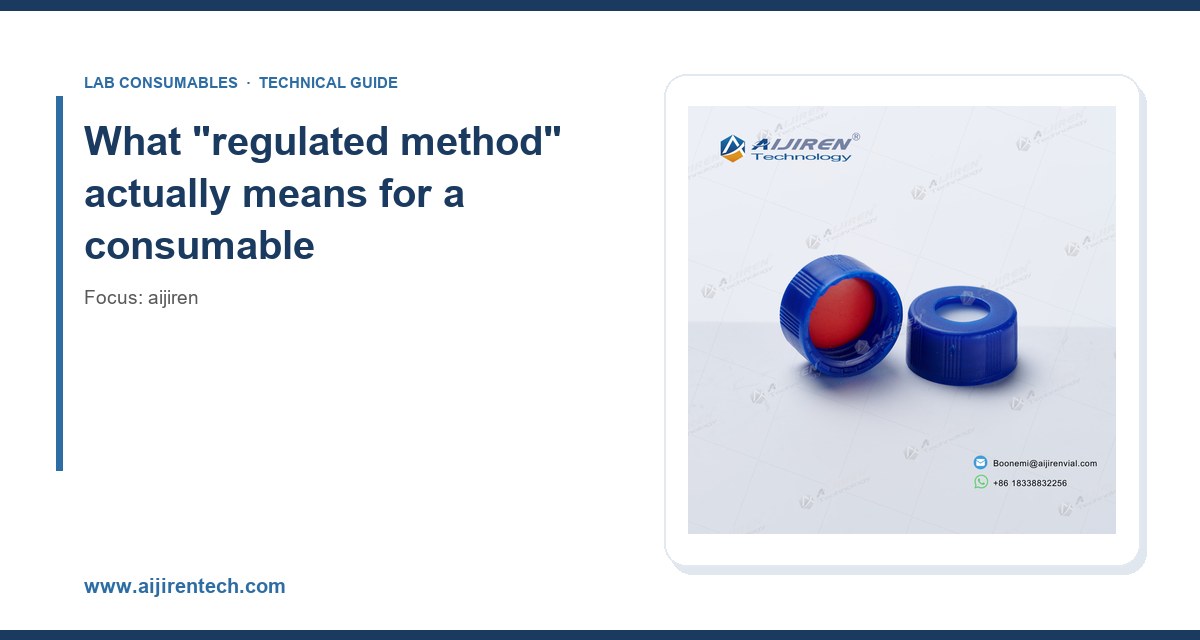
I once watched a validated EPA 8270 method fall apart during a routine audit, and the root cause was not the GC-MS. It was a box of 9 mm screw-thread vials with a septa lot that had been sitting in a warehouse for two years. The method was fine. The documentation was fine. The consumable was not, and nobody had written a specification for it. That experience reshaped how I think about “aijiren” in regulated work. The consumable is part of the method, and if it is not controlled, it is a variable you did not account for.
This article is about how to treat lab consumables, specifically vials, caps, septa, and the associated sample handling hardware, as controlled components inside regulated analytical methods. I will cover what the U.S. EPA, ISO, and AOAC frameworks actually require of you, where consumables fit, and how to build a defensible specification. I will also give you the numbers I use, the failure modes I have dealt with, and a decision checklist you can drop into your SOP.
Regulators do not typically regulate vials. They regulate the method, and the method is a written procedure that includes sample preparation, standards, instrument conditions, and quality control. The consumable sits inside sample preparation and sample introduction, which means it is covered by the method even when it is not named. When an auditor asks “what vial did you use and how do you know it is fit for purpose,” the answer has to be documented, not verbal.
The three frameworks you will encounter most in environmental, food, and pharmaceutical work are SW-846 (EPA), the ISO 17025 and ISO 17034 family, and AOAC Official Methods. Each treats consumables differently, and it is worth being precise about that.
EPA SW-846 and the performance-based philosophy
SW-846 is the EPA’s test methods for evaluating solid waste, and it is deliberately performance-based. The methods describe what the result must achieve, not every piece of hardware you must buy. That flexibility is a gift and a trap. It is a gift because you can optimize. It is a trap because you have to justify every choice you make, and the justification lives in your data package.
Under SW-846, the relevant consumable questions are: does the vial or septum contribute to the blank, does it adsorb the analytes, does it introduce a leachable interference, and is the choice consistent across batches? For volatile methods like 8260, the vial and septum are effectively part of the sample container, and the headspace is part of the analytical system. For semivolatile methods like 8270, the concern shifts to adsorption of high-molecular-weight analytes on active surfaces and to phthalate and plasticizer contamination from septa and cap liners.
If you want the primary source, the EPA maintains the full SW-846 compendium at U.S. EPA SW-846 test methods. Read the method introduction and the quality control sections, not just the analytical procedure. The QC sections are where consumable-related blanks and contamination get addressed.
ISO 17025, ISO 17034, and the supplier question
ISO 17025 is the competence standard for testing and calibration laboratories. It requires you to evaluate suppliers, control purchased services and supplies, and maintain records of that evaluation. ISO 17034 is the standard for reference material producers. Neither standard tells you what septa to buy. Both tell you that you must be able to show you evaluated what you bought and that it met your stated requirement.
This is where a written consumable specification becomes the single most useful document in your quality system. It converts “we buy vials from a supplier” into “we buy 9 mm screw-thread vials, 32 x 11.6 mm, with a 1.0 mm silicone/PTFE septa, certified for less than 5 µg/L phthalate extractables, from an approved supplier with a certificate of analysis on file.” That sentence is auditable. The first sentence is not.
AOAC Official Methods and the matrix problem
AOAC methods are common in food, feed, and dietary supplement testing. They tend to be more prescriptive about sample handling than SW-846, and many AOAC methods specify the container type or the autosampler format. When an AOAC method references a specific vial format, you use that format, or you validate the deviation. The AOAC approach is closer to “follow the method as written,” which means the consumable choice is less negotiable than under SW-846.
The practical consequence: if your lab runs both environmental and food methods, you cannot assume one vial configuration serves both. You can, but you have to validate it, and validation costs more than a second SKU.
Where consumables enter the method
I break consumable exposure into four zones. Each has different requirements and different failure modes.
Zone 1: sample collection and storage
This is the highest-risk zone and the one most often under-specified. The vial is the sample container, and the sample container is part of the chain of custody. For volatile organic compounds, the container must be headspace-free, sealed, and stored at 4 °C ± 2 °C with a documented holding time (often 14 days for preserved aqueous samples under SW-846, with method-specific exceptions). The septum must not adsorb the analytes of interest, and it must not off-gas into the headspace.
For semivolatiles, the concern is adsorption on glass and on active septa. I have seen recovery of high-molecular-weight PAHs drop by 10 to 15 percent when samples sat in vials with unlined or poorly lined caps for extended periods. The fix is a PTFE-faced silicone septum and a documented maximum hold time.
Zone 2: sample preparation
Extraction, dilution, and derivatization all involve transfer between containers. Autosampler vials with limited volume inserts are common here. The failure mode is volume loss and cross-contamination. A 150 µL insert in a 2 mL vial leaves very little margin, and a poorly seated insert will leak or tip. I specify inserts with a polymer foot that locks into the vial, and I check the insert-to-vial fit on every lot.
Zone 3: sample introduction
This is where the autosampler meets the vial. The critical dimensions are the vial height, the septum thickness, and the cap torque. A 9 mm screw-thread vial is nominally 32 x 11.6 mm with a 9 mm thread. A crimp vial is nominally 32 x 11.6 mm with an 11 mm crimp finish. The autosampler needle penetrates the septum, and the septum must reseal well enough to prevent evaporation between injections and well enough to survive multiple punctures if the method reinjects.
For a 12-hour run with 100 injections, a single septum may see 100 punctures if the autosampler reuses the same vial position, which most do not, but the point stands: septum puncture life matters. A good silicone/PTFE septum will take 50 to 100 punctures before coring becomes a problem. A cheap natural rubber septum will core at 10 to 20 and start shedding particles into the vial.
Zone 4: data and documentation
The consumable lot number belongs in the data package. If you cannot trace a result to a vial lot, you cannot investigate a contamination event. I require lot traceability on every consumable that touches a regulated sample, and I keep the certificate of analysis on file for the life of the data package plus the retention period.
Selection criteria with numbers
Here is the specification I use for a general-purpose regulated method. Adjust for your analytes, but start here.
- Vial format: 9 mm screw-thread, 32 x 11.6 mm, clear glass, 2 mL nominal. Screw-thread over crimp for regulated work because it eliminates the crimper as a variable and gives a more consistent seal.
- Glass: Type I borosilicate, USP Type I. Low extractables, low alkali leaching, and it survives autoclaving if your method requires it.
- Septa: silicone/PTFE, 1.0 mm thickness for standard autosamplers, 0.9 to 1.3 mm acceptable range. The PTFE face goes toward the sample. Silicone provides reseal, PTFE provides chemical inertness.
- Cap: polypropylene, 9 mm screw thread, with a documented torque. I use 0.8 to 1.2 N·m for hand-tightened screw caps, checked with a torque tester on a sample of every lot. Over-torque deforms the septum and causes coring. Under-torque causes evaporation.
- Puncture life: minimum 50 punctures per septum for methods with reinjection, verified by a coring test on a representative sample.
- Extractables: phthalate and plasticizer extractables below 5 µg/L for semivolatile methods. Request the supplier’s extractables data, do not assume it.
- Temperature rating: septa rated to at least 200 °C for GC inlet use if the vial is used in a heated context, and caps rated to at least 120 °C for autoclave or hot-block applications.
- Dimensional tolerance: vial height within ±0.2 mm, thread within GPI 9 mm specification. Out-of-tolerance vials cause autosampler gripper errors and needle strikes.
The GPI reference matters. The Glass Packaging Institute thread standards define the 9 mm and 11 mm finishes, and a vial that does not meet GPI will not seal consistently even with a good cap. Ask your supplier for the dimensional conformance statement.
Comparison: screw-thread vs crimp vs snap-cap
This is the decision most labs get wrong because they inherit a format from a method or a predecessor and never revisit it. Here is a concrete comparison for regulated work.
- Screw-thread (9 mm): best seal consistency, no crimper variable, resealable, torque-documented. Higher unit cost (roughly 15 to 25 percent more than crimp). Best choice for regulated methods with audit exposure.
- Crimp (11 mm): lower unit cost, widely supported, but the crimper introduces a variable. Seal quality depends on crimper adjustment, and a poorly crimped vial leaks or cores. Acceptable if you control and verify crimper settings per lot.
- Snap-cap: fastest to use, lowest cost, but the least consistent seal and the highest evaporation risk. I do not recommend snap-caps for regulated methods with volatile analytes or long queue times.
If you are standardizing across a lab, pick one format and validate it once. Mixing formats across methods multiplies your validation burden and your autosampler configuration work.
Operational precautions that actually prevent failures
The failures I have dealt with cluster into a few categories. Here is what I do to prevent each.
Contamination from septa and caps
Septum bleed and cap leachables are the most common source of phantom peaks in semivolatile runs. The fix is threefold: use PTFE-faced septa, run a vial blank with every batch, and condition new septum lots before use. Conditioning means a solvent rinse and a bake at 100 to 150 °C for an hour if the septum rating allows. Check the temperature rating before you bake; a 200 °C-rated septum is fine, a 120 °C-rated one is not.
For trace phthalate work, I go further and dedicate a vial lot to that method. Cross-method vial sharing is how phthalate contamination migrates from a general lab into a trace method.
Evaporation and volume loss
Evaporation shows up as rising internal standard response across a run, or as concentration drift in long sequences. The causes are under-torqued caps, damaged septa, and vials left open too long. I check torque on a sample of every lot, cap vials within 30 seconds of filling, and never leave a filled vial uncapped on the autosampler tray.
Autosampler mechanical errors
Gripper errors and needle strikes are almost always dimensional. A vial that is 0.5 mm too tall will jam a gripper. A vial with a thread that is out of GPI tolerance will not seat. I measure a sample of every lot with calipers and reject lots outside ±0.2 mm on height. This takes ten minutes and saves a night of failed runs.
Adsorption of analytes
High-molecular-weight and polar analytes adsorb on active glass and on silicone. The fixes are silanized glass for polar analytes, PTFE-faced septa, and minimized hold times. For PAHs and similar, I use amber glass to reduce photodegradation and I keep hold times short.
Troubleshooting checklist
When a regulated method starts producing out-of-control results and the instrument checks out, run this checklist before you touch the method.
- Vial blank: run a blank vial from the current lot through the full method. If it shows peaks, the lot is the problem.
- Septa lot change: did the problem start after a septum lot change? Check the lot number against the last good run.
- Torque check: measure cap torque on ten filled vials from the current batch. Outside 0.8 to 1.2 N·m is a finding.
- Dimensional check: caliper ten vials for height and thread. Outside ±0.2 mm is a finding.
- Puncture count: how many punctures has the current septum seen? Above 50 is a coring risk.
- Evaporation check: weigh a filled, capped vial before and after a 12-hour run. More than 2 percent mass loss is a seal problem.
- Storage temperature: verify the 4 °C ± 2 °C storage and the holding time against the method.
- Cross-contamination: did a trace method share vials or septa with a general method? If yes, segregate.
- Certificate of analysis: is the CoA on file for the current lot, and does it match the specification?
- Supplier change: did the supplier change the septum formulation or the glass source without notice? This happens more than suppliers admit.
I keep this checklist as a one-page form. When a run fails, the analyst fills it out before escalating, and nine times out of ten the answer is on the form.
Building the supplier relationship
The most underrated part of regulated consumable management is the supplier relationship. You need a supplier who will tell you when a formulation changes, provide lot-specific extractables data, and hold dimensional tolerances. That is not every distributor. It is a specific kind of supplier, and it is worth paying for.
When I evaluate a supplier, I ask four questions. Do you provide a certificate of analysis per lot with dimensional and extractables data? Do you notify customers of formulation changes? Do you hold GPI dimensional conformance? Can you trace a lot to a manufacturing date and a raw material batch? A supplier who answers all four is a keeper. A supplier who answers two is a risk you are accepting.
For labs that need a broad catalog and fast availability, the major instrument vendors are a reasonable starting point. Agilent maintains a deep catalog of GC columns and accessories that includes autosampler vials and septa, and Thermo Fisher’s chromatography and sample handling line covers the same ground. Restek’s technical resources are genuinely useful when you are troubleshooting a septum bleed or a contamination problem, and their application notes often include the exact consumable specification they used.
For volume purchasing and specification control, I also work with specialist suppliers who will hold a specification for you. That is where Vial Supplier fits, and where Vials With Caps is useful when you want the vial and cap specified as a matched pair rather than sourced separately. The matched-pair approach eliminates the fit problem that causes most seal failures.
If you are building out a chromatography lab and want the consumable specification to sit alongside the instrument and column choices, Lab Chromatography is a reasonable reference point. And for the broader aijiren product context, Aijiren at aijirentech.com is the place to start.
Recommendation
If you run regulated methods and you do not have a written consumable specification, write one this quarter. Start with the vial format, the septum material and thickness, the cap torque, the dimensional tolerance, and the extractables limit. Put it in your quality system as a controlled document. Require a certificate of analysis per lot. Keep lot traceability in the data package.
For most labs, I recommend a 9 mm screw-thread vial, 32 x 11.6 mm, Type I borosilicate, with a 1.0 mm silicone/PTFE septum, polypropylene cap, torqued to 0.8 to 1.2 N·m, specified to ±0.2 mm height tolerance, with phthalate extractables below 5 µg/L and a minimum 50-puncture septum life. That specification is defensible under SW-846, ISO 17025, and AOAC, and it is specific enough that a supplier can meet it and an auditor can check it.
The consumable is not a commodity. It is a controlled component of a regulated method, and treating it that way is the difference between a method that survives an audit and one that does not. I have seen both. The specification is what separates them.
References & further reading
Related resources from our lab consumables network:
- Aijiren at aijirentech.com
- Vials With Caps at vialswithcaps.com
- Vial Supplier at vialsupplier.com
- Lab Chromatography at labchromatography.com
External references and standards: