

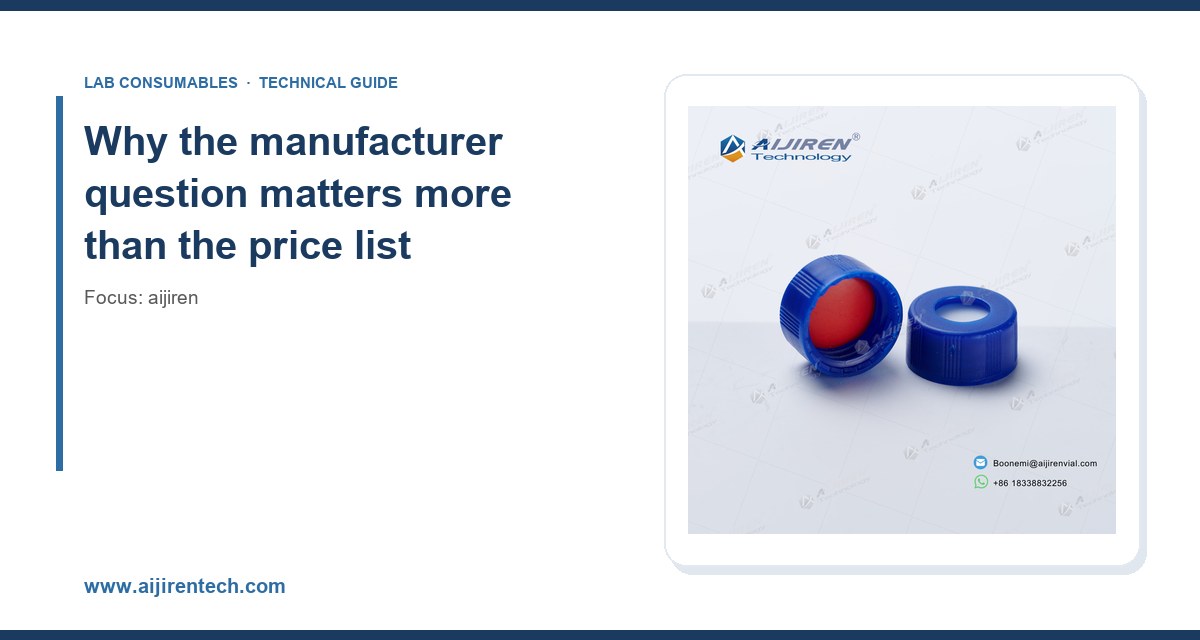
I have spent the better part of fifteen years buying, rejecting, and occasionally rescuing chromatography consumables from factories on three continents. The lesson that cost me the most money is simple: two suppliers can quote you the same 2 mL clear glass vial at the same price per thousand, and one will give you five years of trouble-free autosampler runs while the other quietly erodes your data quality one septum coring at a time. This article is about what actually separates a reliable aijiren manufacturer from a catalog with a logo slapped on it, and how to tell the difference before you sign a supply agreement.
A chromatography consumable looks trivial until it fails. A vial that is 0.3 mm out of dimensional tolerance jams the autosampler tray. A septum with the wrong durometer coring after 40 injections sends rubber shards into the needle and produces ghost peaks at 12.4 minutes that you spend two days chasing. A cap that is not crimped to the right torque leaks carrier gas and shifts your retention times by 0.05 minutes across a 96-well sequence. None of these failures announce themselves. They show up as RSD% creeping from 0.8% to 2.6% on your system suitability check, and by then you have already reported the batch.
So when procurement asks me to qualify a new manufacturer, I do not start with the price list. I start with three questions: what glass are you drawing, what is your dimensional control limit, and can you certify it. The answers separate the operators from the packagers.
This is the same discipline the analytical instrument vendors apply to their own consumable lines. If you look at how Agilent specifies its chromatography consumables and columns or how Thermo Fisher documents sample handling tolerances, you see the same pattern: dimensional windows, material grades, and test methods stated up front. A serious OEM partner should be able to match that level of documentation. If they cannot, they are a trading company, not a manufacturer.
Materials: the part nobody puts on the datasheet
Glass is not glass. The two grades that matter for chromatography vials are Type I borosilicate (borosilicate 3.3, USP Type I) and the cheaper Type III soda-lime or “neutral glass” that some low-cost suppliers quietly substitute. Type I has a linear thermal expansion coefficient of about 3.3 × 10⁻⁶ /K and a hydrolytic resistance that meets USP <660> Type I. Soda-lime expands at roughly 9 × 10⁻⁶ /K and leaches alkali into aqueous mobile phases at pH above 7. If you run LC-MS with a formate buffer at pH 8.2, that difference shows up as sodium adducts and a rising baseline.
What to ask about the glass
- Draw source and lot traceability. Reputable borosilicate comes from a small number of tubing suppliers (Schott, NEG, Corning, and a handful of Chinese tubing mills). Ask for the tubing certificate, not just a generic “borosilicate” statement.
- Hydrolytic resistance test. Demand USP <660> Type I compliance with the actual titration result, not a checkbox.
- Wall thickness uniformity. I want a stated tolerance of ±0.1 mm on the 2 mL vial body. Anything wider and your crimp seal becomes a lottery.
- Annealing. Vials that are not properly annealed carry residual stress and crack at the neck during crimping. Ask for the annealing lehr temperature profile.
Septum and cap materials
The septum is where most OEM quality gaps hide. The common grades are silicone, silicone/PTFE-faced, and butyl. For HPLC and LC-MS the workhorse is a silicone septum with a bonded PTFE face on the sample side, because bare silicone absorbs analytes and sheds particles. The PTFE face must be 0.05 to 0.13 mm thick and bonded, not merely laid on. A laid-on film delaminates after a few hundred punctures and you get silicone extractables in your injection.
Puncture count is the number I use to qualify a septum. A good 10 mm silicone/PTFE septum should survive at least 300 punctures with a 22-gauge needle without visible coring under 10× magnification. Cheap septa fail at 80 to 120. Ask the supplier for their puncture test protocol and the needle gauge they used. If they cannot state the gauge, they did not run the test.
Caps matter too. The two standards you will see are the 13-425 screw thread (for 4 mL and some 2 mL vials) and the GPI 18-400 finish on 2 mL crimp vials, where GPI refers to the Glass Packaging Institute thread/finish standard. A cap that is 0.2 mm off on the thread pitch cross-threads on the autosampler and stalls the tray. I have seen an entire 96-position run abort because one cap lot was out of pitch tolerance.
Material comparison at a glance
| Property | Type I borosilicate | Type III soda-lime | Silicone/PTFE septum | Bare silicone septum |
|---|---|---|---|---|
| Thermal expansion | 3.3 × 10⁻⁶ /K | ~9 × 10⁻⁶ /K | n/a | n/a |
| pH resistance | pH 1 to 14 (short term) | pH 6 to 8 | pH 1 to 12 | pH 3 to 10 |
| Puncture count (22G) | n/a | n/a | 300+ | 80 to 120 |
| Extractables | Low | Moderate (alkali) | Low (PTFE face) | High |
| Typical cost index | 1.0 | 0.6 | 1.0 | 0.5 |
If you are buying vials and caps as a matched set, the fastest way to lock in material consistency is to buy from a supplier who controls both. That is why I point buyers toward the vials with caps range when they need a matched lot, and toward a dedicated vial supplier when they need high-volume replenishment with lot traceability. The point is not the brand name. The point is that the glass and the cap come off the same controlled process.
QC: the difference between a certificate and a test
Every supplier will send you a Certificate of Analysis. Most of them are worthless. A real CoA from a real manufacturer contains measured values against stated limits, a lot number that traces to a raw material lot, and a test method reference. A fake CoA contains the word “conforms” twelve times and no numbers.
Here is the QC stack I expect from a manufacturer I will qualify for regulated work:
Incoming material control
- Glass tubing: lot certificate, hydrolytic resistance spot check, visual inspection for stones and cords.
- Septum compound: durometer (Shore A) check, typically 45 to 55 Shore A for autosampler septa. Too soft and it cores; too hard and the needle bends.
- Caps: thread gauge check against GPI 18-400 or 13-425, torque-to-strip test.
In-process control
- Dimensional inspection: 100% inline vision for body OD, neck ID, and height, with a sampling AQL per ISO 2859-1. I want to see the AQL level and the sample size.
- Crimp torque: for crimp vials, the seal should be set with a crimper calibrated to a defined torque, typically in the range that produces a leak-tight seal without cracking the neck. Ask the supplier what torque they validate to and how they verify it. A common working figure is 0.6 to 0.9 N·m on a manual crimper, but the number that matters is the one the manufacturer can reproduce.
- Leak test: pressure decay or dye penetration on a sample from every lot.
Release testing
- Extractables: USP <661> physicochemical tests on glass, plus a solvent extractables screen (typically methanol and water) with a stated gravimetric limit.
- Functional test: run the lot on a reference autosampler and confirm RSD% on a standard injection is within 1.0% across 10 replicates.
- Puncture test: the 300-puncture protocol described above, with photographic evidence of the septum after test.
If the manufacturer cannot produce release data with numbers, they are not a manufacturer. They are a repackager. The best way to check is to ask for a CoA from a lot you already bought and see whether the numbers match your own incoming inspection. I do this on every new supplier and I have caught three substitution problems in ten years: soda-lime passed off as borosilicate, laid-on PTFE film passed off as bonded, and a cap lot with a 0.4 mm pitch error.
OEM capability: what “we do OEM” actually means
Half the suppliers on any B2B platform claim OEM capability. Almost none can do it. Real OEM capability means four things: tooling you control, private-label documentation, batch-size flexibility, and engineering support when your specification changes.
Tooling and molds
If a supplier cannot tell you which mold your vial came from, they cannot control your dimensional consistency. A serious OEM partner tracks mold cavity numbers and can isolate a problem to a single cavity. I once traced a 0.15 mm height variance to cavity 7 of a 24-cavity mold. The supplier who could not name their cavities took three weeks to find the same problem and never fixed it.
Private-label documentation
OEM is not just a printed box. It is a CoA with your part number, your specification limits, and your lot numbering scheme. It is a drawing controlled to your revision. It is a change-control notification clause that requires the manufacturer to tell you 90 days before they change a raw material source. That last clause is the one that saves you from a silent glass change that invalidates your validation package.
Batch-size flexibility
Ask for the minimum order quantity (MOQ) and the changeover cost. A real OEM line can run 5,000-piece lots for a new product launch and scale to 500,000-piece lots for routine supply without a requalification. A packager will quote you one MOQ and one lead time and mean it.
Engineering support
The test is simple: ask them to quote a custom dimension. Say you need a 2 mL vial with a 0.1 mm tighter neck ID for a specific autosampler. A real manufacturer comes back with a tooling lead time, a sample plan, and a price delta. A packager comes back with “we will check with the factory.”
This is the capability level I associate with the Aijiren manufacturing operation, and it is the standard I hold any OEM partner to regardless of the name on the box.
A decision checklist you can actually use
Here is the scorecard I use to qualify a manufacturer. Score each line 0 (no), 1 (partial), 2 (yes). A supplier needs 18 of 24 to enter a trial, and 22 of 24 to become a primary source.
| # | Criterion | Target / evidence required | Score |
|---|---|---|---|
| 1 | Glass grade stated | USP Type I borosilicate, tubing cert on file | 0/1/2 |
| 2 | Hydrolytic resistance | USP <660> Type I, titration result per lot | 0/1/2 |
| 3 | Dimensional tolerance | Body OD/height ±0.1 mm, stated on drawing | 0/1/2 |
| 4 | Septum durometer | 45 to 55 Shore A, measured per lot | 0/1/2 |
| 5 | PTFE face bonded | 0.05 to 0.13 mm, bonded not laid-on | 0/1/2 |
| 6 | Puncture count | 300+ at 22G, protocol and photos on file | 0/1/2 |
| 7 | Thread standard | GPI 18-400 or 13-425, gauge verified | 0/1/2 |
| 8 | Crimp torque | Validated torque value, calibration record | 0/1/2 |
| 9 | Leak test | Pressure decay or dye per lot | 0/1/2 |
| 10 | Extractables | USP <661> plus solvent screen | 0/1/2 |
| 11 | Functional RSD | ≤1.0% across 10 replicates | 0/1/2 |
| 12 | Lot traceability | Finished lot to raw material lot | 0/1/2 |
| 13 | Mold cavity tracking | Cavity ID on record, isolation possible | 0/1/2 |
| 14 | Change control | 90-day notification clause | 0/1/2 |
| 15 | OEM documentation | CoA to your part number and limits | 0/1/2 |
| 16 | MOQ flexibility | 5k to 500k without requalification | 0/1/2 |
| 17 | Custom tooling | Quoted lead time and sample plan | 0/1/2 |
| 18 | Audit access | On-site or video audit allowed | 0/1/2 |
| 19 | ISO 9001 | Current certificate, scope covers vials | 0/1/2 |
| 20 | ISO 17025 or equivalent | In-house lab accredited or third-party tested | 0/1/2 |
| 21 | Complaint history | Stated CAPA process and response time | 0/1/2 |
| 22 | Reference customers | Two verified pharma or contract lab accounts | 0/1/2 |
| 23 | Lead time | Stated with buffer, not best-case | 0/1/2 |
| 24 | Price stability | 12-month locked pricing or index formula | 0/1/2 |
Print this. Take it to the audit. Do not accept a verbal “yes” on any line. If a supplier scores 24 without blinking, they are lying, because nobody is perfect on line 21.
Operational precautions that catch bad lots early
Even a qualified manufacturer ships the occasional bad lot. The goal is to catch it before it reaches a validated method. Here is what I do on incoming inspection:
- Dimensional spot check. Measure 30 vials per lot with a calibrated caliper. Reject the lot if more than 2 exceed the ±0.1 mm window.
- Septum puncture test. Run 50 punctures with a 22G needle on 5 septa. Inspect under 10× magnification. Any visible coring is a reject.
- Leak check. Fill 20 vials with water, cap and crimp to the validated torque, invert for 30 minutes. Any seepage is a reject.
- Functional RSD. Run a 10-injection sequence on a reference standard. RSD above 1.0% triggers a full investigation.
- Extractables screen. Evaporate 1 mL of methanol from a blank vial and weigh the residue. Compare against the CoA limit.
These five checks take about two hours per lot. They have saved me more than two hours of investigation dozens of times over.
Troubleshooting checklist: when the consumable is the suspect
When a method drifts, the consumable is the last thing most analysts blame and the first thing I check. Work through this list in order:
Symptom: rising RSD% on system suitability
- Check septum coring on the autosampler needle. Replace the septum and re-run.
- Check cap torque. Under-torqued caps leak and cause injection volume variation.
- Check for vial height variance. Measure 10 vials from the current lot.
- Check needle depth. A 0.2 mm height change moves the needle tip relative to the sample.
Symptom: ghost peaks or carryover
- Bare silicone septum absorbing analytes. Switch to silicone/PTFE-faced.
- Laid-on PTFE film delaminating. Inspect the septum face under magnification.
- Soda-lime glass leaching at high pH. Confirm glass grade against the CoA.
Symptom: autosampler jams
- Thread pitch error. Gauge the caps against GPI 18-400 or 13-425.
- Cap OD out of tolerance. Measure 20 caps from the lot.
- Crimp too tight, deforming the neck. Re-check crimper torque calibration.
Symptom: baseline drift on LC-MS
- Sodium adducts from soda-lime glass. Switch to Type I borosilicate.
- Extractables from an unqualified septum lot. Run the methanol evaporation screen.
- Residual mold release agent on caps. Ask the manufacturer for their cleaning protocol.
For method-level context on how these consumable failures interact with column performance and system suitability, the Restek technical resources are the reference I hand to new analysts, and the U.S. EPA SW-846 test methods give you the regulatory framework for extractables and leachables in environmental work. If your lab runs regulated methods, the consumable qualification has to sit inside that framework, not beside it.
What I recommend, with numbers
For a general-purpose HPLC or LC-MS lab running 2 mL autosampler vials, here is the specification I would put in a purchase order today:
- Vial: 2 mL, 12 × 32 mm, USP Type I borosilicate, clear or amber, body OD tolerance ±0.1 mm, height tolerance ±0.2 mm.
- Cap: 9 mm screw, GPI 18-400 finish, polypropylene, with a bonded silicone/PTFE septum.
- Septum: silicone 45 to 55 Shore A, PTFE face 0.05 to 0.13 mm bonded, 300+ punctures at 22G without coring.
- Crimp torque (if crimp vials): validated value in the 0.6 to 0.9 N·m range on a calibrated crimper, verified per shift.
- Release data: CoA with USP <660> and <661> results, dimensional data, puncture test, and functional RSD ≤1.0%.
- Change control: 90-day notification on raw material source changes.
- Traceability: finished lot to raw material lot to mold cavity.
That specification is not exotic. It is what the better manufacturers already do. The gap is that most buyers never ask, so most suppliers never bother to prove it. If you are sourcing chromatography consumables and want a manufacturer who can meet this spec, start with the lab chromatography range and hold them to the checklist above.
The takeaway is blunt: a reliable manufacturer is the one who can hand you a drawing with tolerances, a CoA with numbers, a puncture test with a needle gauge, and a change-control clause with a date. Everything else is a price list with a logo. Qualify on those four documents and the consumable stops being the variable in your method.
References & further reading
Related resources from our lab consumables network:
- Aijiren at aijirentech.com
- Vials With Caps at vialswithcaps.com
- Vial Supplier at vialsupplier.com
- Lab Chromatography at labchromatography.com
External references and standards: