

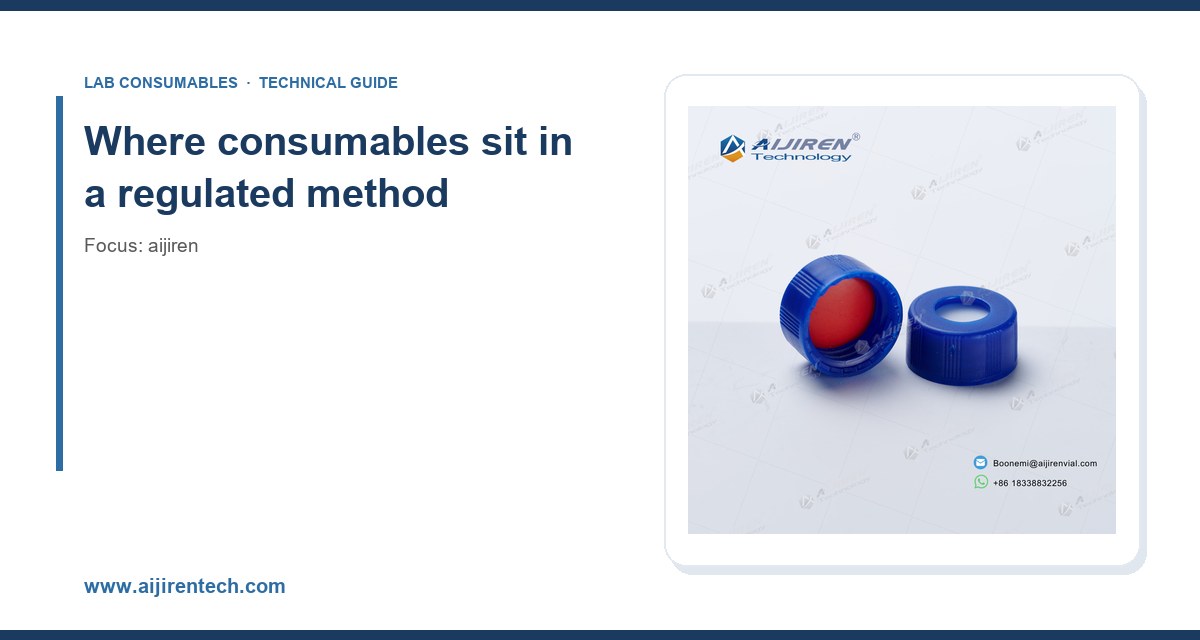
I spent the better part of a week last year chasing a 6% relative standard deviation on a method that had passed validation two years earlier. The column was clean, the autosampler was calibrated, the standards were fresh. The culprit was a batch of 9 mm screw-thread vials with a septum that had been sitting in a warehouse for eighteen months. The liner had hardened just enough that the needle coring changed, and the resulting fragments were partially occluding the inlet. That is the kind of thing that regulated methods punish you for, because under EPA, ISO, or AOAC frameworks, the method is not just the chemistry. It is the entire chain of consumables, dimensions, and material specifications that the method assumes you are using. If you swap any link, you own the verification work.
This article is about aijiren consumables in that regulated context. Not the marketing version, the audit version. What the standards actually require, where consumables sit in the compliance hierarchy, and what numbers you need on a specification sheet before a QA reviewer will sign off.
Regulated analytical methods are written at a level of abstraction that leaves room for interpretation, and that room is where compliance failures live. A method like EPA 8270E for semivolatile organics will tell you to use a specific column dimension and a specific injection volume, but it will not tell you which vial, which septum, which cap torque. Those decisions are yours. The method assumes a baseline of consumable quality that is never spelled out.
ISO/IEC 17025:2017 clause 6.4 covers “facilities and environmental conditions” and clause 6.5 covers “metrologically traceable measurement.” Neither mentions vials by name, but both bear on them. If your autosampler vial leaches plasticizers into a blank, you have an environmental condition problem. If your injection volume is not reproducible because the septum is coring, you have a traceability problem. Auditors know this. They will ask for your consumable qualification records even when the standard does not explicitly require them.
The practical hierarchy looks like this:
- Tier 1 (method-mandated): Column chemistry, dimensions, and particle size. These are written into the method and cannot be changed without revalidation.
- Tier 2 (method-referenced): Detector settings, carrier gas purity, temperature programs. These are specified with tolerances.
- Tier 3 (method-silent, but performance-critical): Vials, caps, septa, syringes, filters, inlet liners. The method assumes these are fit for purpose. You have to prove it.
Tier 3 is where I see the most audit findings, because it is the tier nobody documents. A lab will have a beautiful SOP for column conditioning and nothing at all for vial lot verification. That asymmetry is a liability.
What EPA SW-846 actually expects from your consumables
EPA SW-846 is the test methods manual for evaluating solid waste, and it is the reference framework for most US environmental labs. The methods are performance-based, which is a polite way of saying the Agency does not care how you get there as long as you demonstrate the data quality objectives are met. That freedom is a trap for the unprepared.
Method 8260D (volatile organics by GC-MS) requires a purge-and-trap or headspace introduction. The method specifies that “all glassware shall be cleaned and heated” and that “samples shall be collected in vials with minimal headspace.” That last clause is the only vial guidance in the method, and it is doing a lot of work. Minimal headspace means different things to different analysts. In practice, you need a vial that seals reliably at the fill volume your autosampler can handle, and a septum that does not permit volatiles to escape during the holding time.
For 40 mL VOA vials, the standard is a 24 mm screw thread with a PTFE-faced silicone septum. The GPI 24-400 thread is the de facto standard, and the septum thickness matters more than most people realize. A 0.125 inch (3.2 mm) septum gives you a better seal than the 0.060 inch version, but it also changes the pierce force and the needle penetration depth. If your autosampler is set up for one and you switch to the other without adjusting, you will get coring.
Method 8270E (semivolatiles) is less prescriptive on vials but more prescriptive on injection. The method specifies a 1 µL injection into a split/splitless inlet at 250 to 300 °C. At those temperatures, the septum is the weak point. A standard silicone septum will bleed siloxanes at 300 °C, and those siloxanes show up as background peaks in the extracted ion chromatogram. You need a septum that is either dual-layer (PTFE-faced) or a higher-grade silicone with low bleed characteristics. The cost difference is a few cents per vial. The cost of a failed method blank is a re-extraction and a re-run.
If you are sourcing for SW-846 work, the EPA SW-846 test methods page is the authoritative reference, and it is worth reading the method-specific appendices rather than relying on secondary summaries. The appendices contain the quality control acceptance criteria that your consumables have to support.
ISO methods and the traceability chain
ISO methods are more prescriptive than EPA methods in some ways and less in others. ISO 17025 accreditation requires you to demonstrate that your measurements are traceable to a reference, and for chromatographic methods that traceability runs through the calibration standards, the balance, the volumetric glassware, and the injection system. The vial is part of the injection system whether the standard says so or not.
ISO 11890-2 for volatile organic compound content in paints and coatings is a good example. The method specifies a headspace or direct injection approach and requires a relative standard deviation of less than 5% across duplicate injections. That RSD is achievable with commodity vials on a good day, but it is not robust. A vial with a poorly molded neck will seat inconsistently in the autosampler tray, and the resulting injection volume variation will push you past 5% on a bad day. The fix is not better technique. It is a vial with tighter dimensional tolerance.
What does that tolerance look like in practice? For a 2 mL autosampler vial, the critical dimensions are:
- Outer diameter: 11.6 mm ± 0.2 mm (the autosampler tray pocket is sized for this)
- Height: 32 mm ± 0.5 mm (affects needle penetration depth)
- Neck inner diameter: 6.0 mm ± 0.1 mm (affects septum seating)
- Bottom geometry: flat or conical, with the conical version having a 0.25 mL residual volume
If your supplier cannot give you those numbers on a certificate of analysis, you are buying on faith. For regulated work, faith is not a defensible position. This is where sourcing discipline matters, and it is why I recommend working with a supplier who publishes dimensional data. Vial Supplier is one of the few that does, and it makes the qualification paperwork much easier.
AOAC methods and the matrix problem
AOAC methods are used heavily in food, feed, and agricultural testing, and they bring a different set of consumable challenges. The matrices are dirtier, the sample preparation is more aggressive, and the methods often specify filtration or cleanup steps that are consumable-intensive.
AOAC 2007.01 for pesticide residues in foods, for example, uses a QuEChERS extraction followed by dispersive solid-phase cleanup and LC-MS/MS or GC-MS/MS analysis. The method specifies a 50 mL centrifuge tube for extraction and a 2 mL microcentrifuge tube for the final extract. The consumable quality issues here are different from environmental work. You are worried about plasticizers leaching from the tube into the extract, and you are worried about the tube failing under centrifugation.
Polypropylene is the standard material for QuEChERS tubes, and the grade matters. A low-grade polypropylene will contain slip agents and antioxidants that leach into acetonitrile and show up as background in the MS. The fix is to specify medical-grade or USP Class VI polypropylene and to run a solvent blank through the tube before you commit a batch. I have seen labs fail a proficiency test because of a tube change that nobody documented.
Centrifugation is the other failure mode. A 50 mL tube spun at 4,000 × g for 5 minutes will fail at the cap if the cap is not rated for it. The standard cap is a screw cap with a GPI 24-410 thread, and the torque spec is typically 15 to 20 inch-pounds. Under-torque and the tube leaks. Over-torque and the cap cracks. A torque wrench is not optional equipment in a regulated lab.
Selection criteria with numbers
Here is the decision checklist I use when qualifying a consumable for a regulated method. It is not exhaustive, but it covers the failure modes I have actually seen in audits and proficiency tests.
Vial selection
- Volume: 2 mL for autosampler work, 40 mL for VOA, 20 mL for headspace. Match the fill volume to the method’s minimum and maximum.
- Material: Type I borosilicate glass for pH-sensitive analytes, Type 33 borosilicate for general use. Avoid soda-lime glass for anything above pH 8.
- Neck finish: 9 mm screw thread for autosampler work, 11 mm crimp for high-temperature applications, 24 mm for VOA. The thread standard is GPI, and the dimensional tolerances are in the GPI specification.
- Certification: Look for a certificate of analysis that includes dimensional data, extractable background, and lot traceability. If the supplier cannot provide it, move on.
Septum selection
- Material: Silicone for general use, PTFE-faced silicone for high-temperature or reactive analytes, butyl rubber for volatile work where bleed is a concern.
- Thickness: 0.125 inch (3.2 mm) for standard autosampler work, 0.060 inch (1.5 mm) for high-throughput where pierce force matters.
- Puncture count: A standard silicone septum is good for 3 to 5 punctures before coring becomes a risk. PTFE-faced septa are good for 5 to 10. If your method requires multiple injections from the same vial, plan for septum replacement or use a vial with a pre-slit septum.
- Temperature rating: Standard silicone is rated to 200 °C. PTFE-faced silicone is rated to 250 °C. High-temperature silicone is rated to 300 °C. Do not exceed the rating, because the septum will degrade and you will see it in the chromatogram.
Cap selection
- Material: Polypropylene for general use, phenolic for high-temperature work. Phenolic caps are more expensive but they do not deform at 300 °C.
- Torque: 15 to 20 inch-pounds for 24 mm screw caps, 8 to 12 inch-pounds for 9 mm screw caps. Use a torque wrench and document the setting in your SOP.
- Septum retention: The cap should hold the septum flat and centered. A cap that allows the septum to rotate will cause coring.
For a broader view of the consumable landscape, the Agilent chromatography consumables and columns catalog is a useful reference for what good looks like, and Thermo Fisher chromatography and sample handling publishes similar data. Neither is a substitute for your own qualification work, but they are good benchmarks.
Operational precautions that actually matter
The biggest consumable-related failure I see in regulated labs is not a bad product. It is a good product used wrong. Here are the precautions that matter.
Storage and shelf life
Septa have a shelf life. Silicone oxidizes, and an oxidized septum will bleed more and seal less. The practical shelf life is two years from manufacture for sealed bags, and six months once the bag is opened. If your lab stocks a year’s worth of septa in an open bin, you are asking for trouble. Store them in the original packaging, in a cool dry place, and rotate stock.
Injection volume and needle depth
The needle depth is set by the autosampler, and it has to match the vial. A needle that goes too deep will hit the bottom of the vial and bend. A needle that does not go deep enough will draw from the headspace and give you a low injection volume. For a 2 mL vial with a conical bottom, the standard needle depth is 2 to 3 mm above the bottom. Check it every time you change vial lots.
Septum coring
Coring is the failure mode that everyone knows about and nobody prevents. The fix is a combination of needle quality, septum quality, and injection technique. Use a needle with a beveled tip rather than a sharp point, because a sharp point cores more easily. Use a septum that is rated for the number of punctures you need. And do not over-torque the cap, because a compressed septum cores more easily.
If you are seeing coring, check the needle first, then the septum, then the cap torque. In that order. I have seen labs replace an entire batch of septa when the real problem was a bent needle.
Troubleshooting checklist
When a regulated method fails, the consumable is one of several suspects. Here is the checklist I use to rule it in or out.
- Blank contamination: Run a solvent blank through a new vial and septum. If you see peaks, the consumable is the source. Common culprits are plasticizers from caps and siloxanes from septa.
- RSD failure: Check the vial dimensions first. A vial with a warped neck will not seat consistently. Then check the septum for coring. Then check the needle.
- Carryover: Check the vial residual volume. A conical vial with a 0.25 mL residual will carry over more than a flat-bottom vial. If your method requires low carryover, use a conical vial and a small injection volume.
- Peak shape changes: Check the septum for bleed. A degraded septum will show up as a rising baseline or as siloxane peaks in the mass spectrum. Replace the septum and re-run the blank.
- Leak failures: Check the cap torque. A cap that is under-torqued will leak during headspace analysis. A cap that is over-torqued will crack. Use a torque wrench and document the setting.
- Lot-to-lot variation: Check the certificate of analysis. If the supplier cannot provide dimensional data, you cannot rule out a lot change as the cause. This is why lot traceability matters.
For more on the chromatography side of this, the Restek technical resources are a good reference for troubleshooting and method development, and they publish a lot of the data that suppliers should be giving you.
A recommendation with concrete parameters
If you are running regulated methods and you want a consumable specification that will survive an audit, here is what I recommend.
For environmental work under SW-846, use 2 mL clear glass autosampler vials with 9 mm screw thread and PTFE-faced silicone septa, rated to 250 °C, with a certificate of analysis that includes dimensional data and extractable background. For VOA work, use 40 mL amber glass vials with 24 mm GPI thread and 0.125 inch PTFE-faced silicone septa, torqued to 15 to 20 inch-pounds. For headspace work, use 20 mL vials with 20 mm crimp caps and butyl rubber septa, because butyl has lower bleed than silicone at headspace temperatures.
For food and agricultural work under AOAC, use 50 mL polypropylene centrifuge tubes with GPI 24-410 caps, rated for 4,000 × g, and 2 mL microcentrifuge tubes for the final extract. Specify medical-grade polypropylene and run a solvent blank before you commit a batch.
For all of it, document the qualification. The qualification record should include the supplier, the lot number, the certificate of analysis, the dimensional check, the blank check, and the date. That record is what an auditor will ask for, and it is what you will need if a method fails and you have to rule out the consumable as the cause.
If you are sourcing consumables for regulated work, the Vials With Caps catalog is a good starting point for matched vial and cap sets, and Lab Chromatography has the broader consumable range. For aijiren specifically, the Aijiren product line covers the 9 mm and 24 mm formats that most regulated methods assume, and the certificates of analysis are available on request. That last point is the one that matters most. A supplier who will give you the data is a supplier you can qualify. A supplier who will not is a supplier you cannot defend in an audit.
Takeaway
Regulated methods do not specify consumables because the standards writers assumed a baseline of quality that was true when the methods were written. That assumption is no longer safe. The dimensional tolerances on vials have widened, the septum materials have changed, and the supply chain has more lots and more sources than it did twenty years ago. If you are running EPA, ISO, or AOAC methods, you have to qualify your consumables the same way you qualify your columns and your standards. That means specifications with numbers, certificates of analysis with lot traceability, and a qualification record that an auditor can review. The cost of that discipline is a few hours of paperwork per lot. The cost of skipping it is a failed method, a re-run, and a finding on your next audit. I know which one I would rather pay.
References & further reading
Related resources from our lab consumables network:
- Aijiren at aijirentech.com
- Vials With Caps at vialswithcaps.com
- Vial Supplier at vialsupplier.com
- Lab Chromatography at labchromatography.com
External references and standards: