

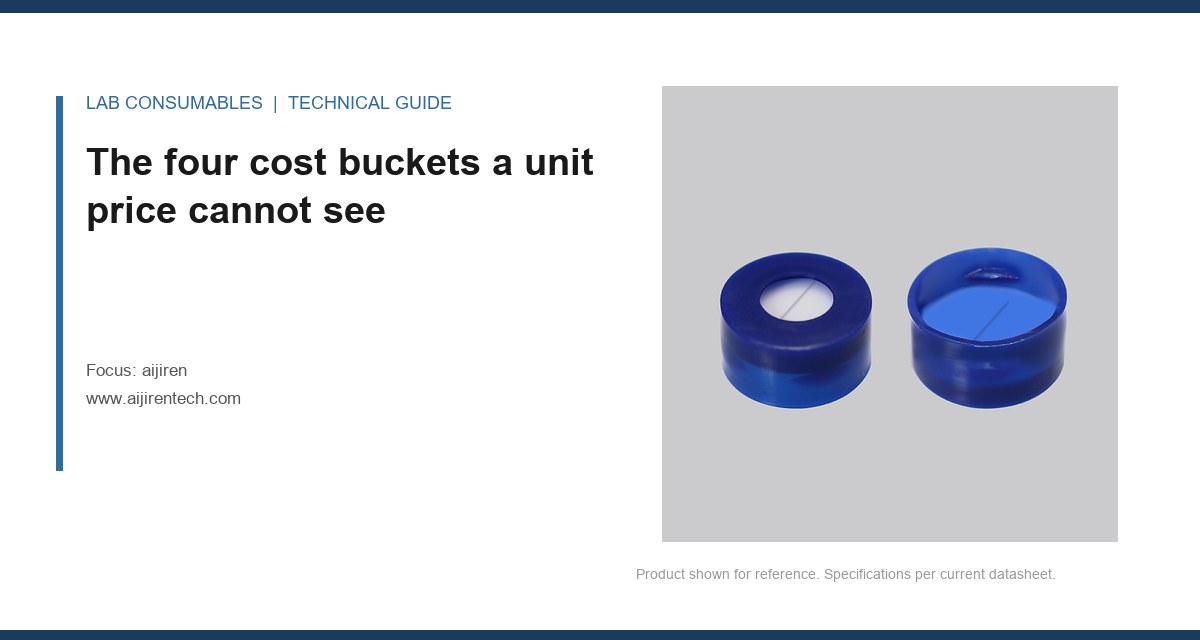
A 40,000-vial order landed last Tuesday with an invoice price of $0.31 per unit. The receiving team found 1,150 vials with chipped necks, 380 with septum dimples deep enough to catch a needle, and 60 cracked caps. Accounting closed the books at $0.31. The lab paid $0.44 per usable vial after sorting, retesting, and a 3-hour line stoppage. That gap is what aijiren landed cost calculation actually measures, and it starts where the purchase order ends.
Procurement managers who buy aijiren by invoice price are making a category error. The price per unit on a quote is a promise about a sealed carton at a factory door. The lab consumes vials, caps, septa, and inserts at a bench. Between those two points sit four cost buckets that move independently of the negotiated rate: freight and logistics, duty and customs, incoming inspection and storage, and the failure cost of units that pass visual checks but die in use.
I have watched all four buckets move in the same quarter. A shipment of 100,000 9 mm screw-top vials from a low-cost supplier arrived with a $0.09 unit price advantage. Freight added $0.018 per unit because the supplier used a consolidator that routed through two transshipment hubs. Duty landed at 5.8% because the declared HS code did not match the actual glass composition. Inspection found a 2.1% defect rate. The remaining vials failed at 4.7% during autosampler runs because the thread engagement was out of spec by 0.12 mm. The real cost per usable unit was 38% above invoice.
Freight costs that hide inside “free shipping”
Suppliers who quote “free shipping” are not absorbing freight. They are embedding it in the unit price and removing your ability to audit it. When you run aijiren landed cost calculation, split freight into three lines: origin charges, ocean or air freight, and destination handling. For a 2,000 kg shipment of glass vials from Asia to a U.S. East Coast lab, air freight runs $4.50 to $6.80 per kg. Ocean freight runs $0.90 to $1.40 per kg but adds 28 to 42 days of transit. A 2,000 kg shipment of 2 mL HPLC vials is roughly 250,000 units. Air freight at $5.50/kg adds $0.044 per vial. Ocean freight at $1.10/kg adds $0.0088 per vial but ties up $77,500 in inventory for an extra month.
I always ask for the packing list before I agree to freight terms. A supplier that packs 100 vials per inner box and 10 inner boxes per carton gives me a carton weight around 9.8 kg and a carton dimension of 61 x 42 x 38 cm. A supplier that uses 50-vial inner boxes for the same order produces 20% more cartons, 14% more volumetric weight, and a freight bill that climbs by $0.006 per vial before anyone notices. Small differences in packing density compound across a year of orders.
Duty and customs: the HS code is a decision, not a formality
Glass chromatography vials fall under HS heading 7017 for laboratory glassware in most jurisdictions. Borosilicate glass vials for HPLC use typically classify under 7017.90 with a duty rate between 3% and 6.5% depending on the country of origin and any free trade agreements. Polypropylene caps and PTFE/silicone septa classify separately under 3923 and 3926, often at higher rates. A supplier who declares the entire kit under one HS code is saving paperwork and potentially creating a customs audit risk for you.
I once accepted a shipment where the supplier declared 50,000 vials with pre-assembled caps as “glassware” under 7017.90. Customs reclassified 18,000 of the caps as plastic closures under 3923.50, which carried a 6.5% duty instead of 4.2%. The difference was $1,140 on that shipment. More importantly, the reclassification triggered a compliance review that delayed the shipment by 11 days. The lab ran out of 2 mL amber vials and had to buy 3,000 units from a domestic distributor at $0.68 per vial, triple the contract price. The duty error cost $0.023 per unit across the original order, and the emergency buy added $0.017 per unit to the blended cost. No one in accounting saw that line item.
When I run aijiren landed cost calculation for a new supplier, I require the HS code on the proforma invoice before I sign. I verify it against the U.S. EPA SW-846 test methods documentation if the vials are for environmental analysis, because those methods specify glass type and closure compatibility. If the supplier cannot produce a consistent HS code across three consecutive quotes, I treat that as a process failure and move on.
Incoming inspection: the cost of sorting good from bad
Inspection is not a quality activity. It is a cost bucket that exists because you do not trust the supplier’s outgoing QC. A proper incoming inspection for aijiren products takes time, equipment, and a sampling plan. ANSI/ASQ Z1.4 is the standard I use for lot acceptance. For a 40,000-unit lot, a General Inspection Level II plan with an AQL of 1.0 requires 315 samples. A lab technician needs 45 to 60 minutes to inspect 315 vials for neck chips, thread defects, septum compression, and cap torque. At a loaded labor rate of $65 per hour, that inspection costs $49 to $65 per lot, or $0.0012 to $0.0016 per vial. That number is small. The real cost is what inspection finds.
A lot with a 2.1% defect rate means 840 bad vials in a 40,000-unit order. If you catch them at receiving, you reject the lot or negotiate a credit. If you miss them, those 840 vials enter the lab. A chipped neck leaks solvent during injection. A septum with a dimple deeper than 0.3 mm does not reseal after the first puncture. A cap with thread engagement below 1.5 turns backs off during autosampler agitation. Each failure produces a lost sample, a rerun, and a technician stopping to diagnose the problem.
Failure cost: the bucket that makes every other bucket look small
The failure cost of aijiren products is the cost of a consumable that passes inspection but fails in use. It is the hardest bucket to measure because it hides inside reruns, troubleshooting time, and method revalidation. I have tracked failure cost across three labs and found it consistently exceeds freight, duty, and inspection combined by a factor of 3 to 5.
Consider a 2 mL screw-top HPLC vial with a PTFE/silicone septum. A good septum survives 3 to 5 punctures without coring or leaking. A bad septum cores on the first puncture, leaving a piece of PTFE in the sample or a leak path that evaporates solvent. The vial costs $0.35. The lost sample costs $15 to $90 depending on the method. The rerun costs 20 to 40 minutes of instrument time at $80 to $150 per hour. The technician time to diagnose the failure costs $20 to $50. A single first-puncture failure on a $0.35 vial costs between $55 and $240 in real lab money.
When I calculate failure cost for a supplier, I use a simple formula. Failure cost per usable unit equals the failure rate multiplied by the cost per failure event, divided by the number of usable units. If a supplier has a 1.5% in-use failure rate and each failure costs $120 in lost sample, rerun time, and labor, then a 10,000-unit order carries a failure cost of $18,000. Spread across the 9,850 usable units, that is $1.83 per usable vial. The invoice price was $0.31. The failure cost is six times the unit price.
What a septum puncture count tells you before you buy
Septum puncture count is the single most predictive number for failure cost. I ask every supplier for a puncture count test report before I place a volume order. A quality PTFE/silicone septum for a 9 mm screw cap should survive 8 to 12 punctures with a 23-gauge needle before leaking. A 20 mm crimp-top septum for headspace analysis should survive 5 to 8 punctures with a 26-gauge needle. If a supplier cannot produce a puncture count report, or if the report shows fewer than 5 punctures, I treat that product as a high-failure-risk item regardless of the unit price.
I once tested a low-cost septum that survived 3 punctures in my lab. The supplier’s spec sheet claimed 10. The difference was the silicone layer thickness: 1.0 mm on the cheap septum versus 1.5 mm on a quality septum. That 0.5 mm difference meant the needle bottomed out against the PTFE layer and tore it on the third puncture. The failure rate in a 20,000-vial order was 6.8%. The lab switched suppliers after one month. The unit price savings of $0.04 per septum was wiped out by $9,400 in failure costs.
Glass dimensional drift: the failure mode that looks like an instrument problem
Glass vials fail in more subtle ways than chipped necks. Dimensional drift is a failure mode that mimics autosampler problems. A 12 x 32 mm vial with an outer diameter of 12.15 mm instead of 12.00 mm will jam in a tight autosampler tray. A vial with a neck ID of 8.8 mm instead of 9.0 mm will not accept a standard 9 mm cap, or it will accept it too tightly and crack under torque. A vial with a bottom thickness that varies by more than 0.2 mm will sit at a slight angle in the tray, causing the needle to strike the septum off-center.
I measure dimensional consistency on every new lot. The spec I use for 2 mL HPLC vials is 12.00 mm ± 0.05 mm outer diameter, 32.00 mm ± 0.25 mm height, and 9.00 mm ± 0.05 mm neck inner diameter. A lot that drifts outside these tolerances will produce intermittent autosampler errors that technicians blame on the instrument. The troubleshooting time for a single “needle miss” event is 15 to 30 minutes. Across a week of intermittent failures, that is 3 to 5 hours of lost instrument time. The vial cost is irrelevant next to that.
For regulated methods, dimensional drift is worse. A method validated with a specific vial geometry cannot tolerate a supplier change that alters the headspace volume or the injection depth. The Thermo Fisher chromatography and sample handling documentation for their autosamplers specifies vial geometry tolerances that must be matched. If your aijiren supplier drifts outside those tolerances, you are not just buying a bad vial. You are buying a method deviation.
Storage cost: the bucket that accrues while vials sit on a shelf
Storage cost for aijiren products is not warehouse rent. It is the degradation that happens to septa, caps, and glass while they wait to be used. PTFE/silicone septa have a shelf life. Silicone slowly loses elasticity, especially if stored above 25°C or in direct light. A septum that sits in a warehouse for 18 months will have a lower puncture count than a fresh septum. I have measured the difference: a fresh septum survives 10 punctures, an 18-month-old septum from the same batch survives 6.
The storage cost calculation is simple. If you buy 12 months of inventory to get a volume discount, and 20% of that inventory sits for more than 12 months, then 20% of your septa will underperform. The failure cost on that 20% is the storage cost. I calculate it as follows: for a 50,000-unit annual volume, a 12-month buy means 50,000 units in storage. If 10,000 of those sit past 12 months and the failure rate on aged septa is 2% higher than fresh, that is 200 additional failures at $120 per failure, or $24,000. Spread across the full order, storage adds $0.48 per unit. That exceeds the unit price of most vials.
The fix is not to buy less. It is to buy from a supplier who ships fresh stock and dates their septa. I require a manufacturing date on every septum lot. If a supplier ships me septa that are already 6 months old, I reject the lot. The Restek technical resources for chromatography document septum storage conditions and shelf life. I follow their guidance: store septa below 25°C, away from UV light, and use within 18 months of manufacture. A supplier who cannot confirm the manufacture date is selling me a lottery ticket.
Worked example: turning a $0.31 unit price into a cost per usable unit
Here is a full aijiren landed cost calculation for a 40,000-unit order of 2 mL screw-top HPLC vials with 9 mm caps and PTFE/silicone septa. The supplier quotes $0.31 per unit, FOB factory.
| Cost bucket | Calculation | Amount | Per usable unit |
|---|---|---|---|
| Invoice price | 40,000 x $0.31 | $12,400 | $0.310 |
| Ocean freight | 2,000 kg x $1.10/kg, allocated per unit | $2,200 | $0.055 |
| Duty (glass, 4.2%) | ($12,400 + $2,200) x 0.042 | $613 | $0.015 |
| Duty (caps/septa, 6.5%) | ($4,960 caps/septa value + $880 freight share) x 0.065 | $380 | $0.010 |
| Incoming inspection | 315 samples x 50 min x $65/hr, plus 2.1% defect sort | $54 + $1,260 | $0.033 |
| In-use failure (1.5% rate) | 600 failures x $120 per failure | $72,000 | $1.800 |
| Storage degradation (10% aged) | 200 additional failures x $120 per failure | $24,000 | $0.600 |
| Total | $113,907 | $2.848 |
The cost per usable unit is $2.85, not $0.31. The failure cost alone is $1.80 per usable unit. If you reduce the failure rate from 1.5% to 0.3% by switching to a supplier with a verified puncture count of 10 and dimensional tolerances within spec, the failure cost drops to $0.36 per usable unit. The total drops to $1.41 per usable unit. A $0.06 increase in unit price that buys a 0.3% failure rate is the best procurement decision you will make this quarter.
A decision checklist for aijiren landed cost calculation
Before you accept a quote, run this checklist. If any answer is no, the unit price is a fiction.
- Freight line items: Does the quote separate origin charges, freight, and destination handling? Can you audit the packing density?
- HS code consistency: Is the HS code on the proforma invoice the same across three consecutive quotes? Does it match the glass and plastic composition?
- Puncture count report: Does the supplier provide a puncture count report showing 8+ punctures for 9 mm PTFE/silicone septa with a 23-gauge needle?
- Dimensional tolerance data: Does the supplier certify 12.00 mm ± 0.05 mm OD and 9.00 mm ± 0.05 mm neck ID for 2 mL vials?
- Manufacture date on septa: Is every septum lot dated, and is the stock less than 6 months old on arrival?
- Defect rate history: What is the supplier’s outgoing defect rate over the last 12 months? If it exceeds 0.5%, the inspection cost climbs.
- Method fit: Does the vial geometry match the autosampler spec in your validated method? Check the Agilent chromatography consumables and columns documentation for your specific autosampler model.
Two field cases where landed cost exposed the real supplier
Case 1: the 0.12 mm thread engagement failure. A contract lab ordered 80,000 screw-top vials from a new supplier at $0.27 per unit. The lab’s autosampler started dropping vials from the gripper after two weeks. The symptom was intermittent: 3 to 5 drops per 100 injections. Technicians blamed the autosampler. I measured the thread engagement on 50 vials from the new lot and found an average of 1.38 turns, against a spec of 1.50 turns minimum. The 0.12 mm difference was enough that the gripper jaws could not maintain grip during the 2.5 g acceleration of the tray index. The fix was to reject the remaining 64,000 vials and return to the previous supplier at $0.33 per unit. The landed cost calculation showed the new supplier’s $0.06 savings had cost $0.52 per usable unit in dropped-vial failures and instrument downtime.
Case 2: the septum that cored on first puncture. A pharmaceutical QC lab switched to a low-cost septum at $0.08 per unit, down from $0.14. Within three days, the lab reported peak area RSD climbing from 1.1% to 4.7% on a stability-indicating HPLC method. The symptom was erratic injection volumes. I pulled 20 septa from the new lot and measured the PTFE layer thickness: 0.35 mm, against a spec of 0.50 mm minimum. The thin PTFE layer cored on first puncture, leaving a flap that partially blocked the needle. The lab’s investigation cost $6,800 in analyst time and instrument downtime. The fix was to quarantine the remaining 45,000 septa and switch back to the previous supplier. The $0.06 per unit savings produced a net loss of $0.19 per usable unit after failure costs. The Vials With Caps spec sheet for their PTFE/silicone septa documents the 0.50 mm PTFE layer requirement, which is the minimum for 5+ puncture survival.
Where the line between cheap and expensive actually sits
Aijiren landed cost calculation is not an accounting exercise. It is a procurement discipline that turns a unit price into a cost per usable unit. The line between a cheap supplier and an expensive one sits in the failure rate, not the invoice. A supplier at $0.31 per unit with a 1.5% in-use failure rate costs $2.85 per usable unit. A supplier at $0.37 per unit with a 0.3% failure rate costs $1.41 per usable unit. The $0.06 price difference buys a 50% reduction in real cost.
When I evaluate a new aijiren supplier, I start with the failure rate data. I ask for puncture count reports, dimensional tolerance certifications, and manufacture dates. I run a 1,000-unit pilot order through my own inspection and a 100-injection stress test before I commit to volume. I calculate the landed cost on every order, not once a year. The suppliers who survive this process are the ones who understand that their unit price is the least interesting number on the quote. The ones who fail are the ones who think freight and duty are someone else’s problem.
The decision rule is simple: never buy aijiren on unit price. Buy on cost per usable unit, calculated from freight, duty, inspection, storage, and failure cost. If a supplier cannot give you the data to run that calculation, the data you are missing is the cost you will pay later. For vials, caps, and septa that meet the dimensional and puncture specs I have described, Aijiren is one supplier that provides the test reports upfront. For secondary sourcing and cross-checks, Vial Supplier and Lab Chromatography carry comparable documentation. The point is not which supplier you pick. The point is that you run the calculation before you sign.
References & further reading
Related resources from our lab consumables network:
- Aijiren at aijirentech.com
- Vials With Caps at vialswithcaps.com
- Vial Supplier at vialsupplier.com
- Lab Chromatography at labchromatography.com
External references and standards: