

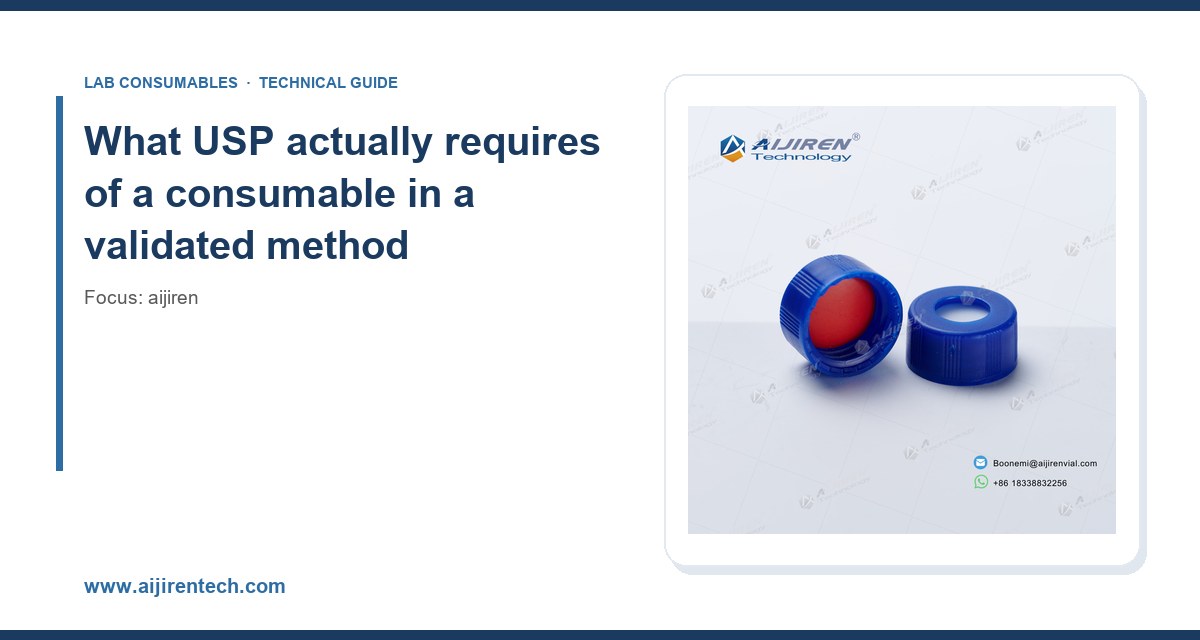
I have sat through three FDA inspections and two client audits where the question of aijiren consumables came up, and the same thing happens every time: the auditor opens the method validation report, flips to the materials section, and asks for the vendor’s regulatory status. The answer that works is never “we buy from aijiren.” The answer that works is a documented chain that ties a specific part number, a specific lot, and a specific USP chapter to the validated procedure. This article walks through how to build that chain for aijiren consumables inside a validated method, with the numbers, the failure modes, and the paperwork that survives an inspection.
USP General Chapter <1225> Validation of Compendial Procedures lays out the validation characteristics (accuracy, precision, specificity, linearity, range, detection limit, quantitation limit, robustness) but it does not name consumables. That is the trap. People read <1225> and conclude the consumable is out of scope. It is not. The consumable enters the method through robustness, through system suitability, and through the materials section of the validation protocol. If your method validation report says “column: C18, 150 x 4.6 mm, 5 µm” but does not lock the vial, the septum, the cap, the liner, or the filter, then the method as written is not the method as run.
USP <621> Chromatography is where the operational requirements sit. System suitability parameters (resolution, tailing factor, theoretical plates, RSD of replicate injections) are measured on the actual hardware, including the consumable. If your septum is bleeding siloxanes, your tailing factor moves. If your vial is adsorbing a basic analyte, your RSD climbs. The chapter does not care that the column is validated. It cares that the system passes suitability on the day.
USP <1058> Analytical Instrument Qualification gives you the framework for grouping. The instrument is qualified (IQ/OQ/PQ). The method is validated. The consumable sits between them, and <1058> is where you justify treating it as a qualified component rather than an uncontrolled reagent. I treat consumables under a component qualification program that mirrors <1058>: define the requirement, test against the requirement, document the result, control the lot.
The materials section is the contract
Every validation protocol I write now has a materials table with a column for “critical attribute” and a column for “acceptance criterion.” For a vial, the critical attributes are: glass type (USP Type I borosilicate), hydrolytic resistance class, residual volume after fill, dimensional tolerance at the neck, and extractables profile. For a septum, they are: compound (silicone, PTFE-faced silicone, butyl), durometer, puncture count, and reseal performance. For a cap, they are: thread form (GPI 13-425, GPI 15-425, 18 mm, 20 mm), torque specification, and septa retention. If a table entry is missing, the auditor will find it.
Mapping aijiren part numbers to USP chapters
Aijiren is a consumables manufacturer, and like every manufacturer in this space, the catalog is organized by product family, not by USP chapter. Your job is the mapping. Here is how I do it, product family by product family.
Vials and glass
USP <660> Containers, Glass is the controlling chapter for glass vials. Type I borosilicate is the default for HPLC and GC autosamplers because it has the lowest alkali release. Type II is surface-treated soda lime, acceptable for some aqueous applications but not for basic analytes or for anything going through a pH excursion. Type III is not acceptable for a validated compendial method in my opinion, and I have never written a protocol that allowed it. When you buy aijiren vials through Vials With Caps, the certificate of analysis should state the glass type and the hydrolytic resistance class per USP <660>. If it does not, ask for it. If it cannot be produced, change suppliers.
The dimensional piece matters more than people think. A 2 mL autosampler vial with a 12 x 32 mm body and an 11 mm crimp neck has a specified neck finish. If the neck OD runs 0.2 mm large, the crimper does not seat the seal, and you get evaporation on a 24-hour autosampler run. I have seen a 3 percent loss of a volatile internal standard over 18 hours from exactly this. That is not a USP failure, it is a method failure, and it traces to a dimensional tolerance nobody checked at incoming.
Septa and closures
USP does not have a dedicated septum chapter, but <381> Elastomeric Closures for Injections covers the extractables and functionality testing framework that I borrow for analytical septa. The relevant tests are: fragmentation (particulates shed on puncture), self-sealing (reseal after puncture), and penetrability (force required). For a validated method, I specify:
- Puncture count: 3 punctures maximum for a 10 mm silicone septum in a validated autosampler method, 5 for a PTFE-faced silicone if the method is short. Beyond that, coring risk rises and the septa starts leaking.
- Durometer: 45 to 55 Shore A for silicone. Softer and the needle bends, harder and the crimper cannot compress it properly.
- PTFE facing: 0.1 to 0.2 mm, bonded, not loose. Loose facing migrates and plugs the needle.
- Temperature rating: silicone to 200 °C, butyl to 120 °C, PTFE-faced silicone to 200 °C with reduced reseal performance above 150 °C.
I have watched a method fail system suitability because the septum was a butyl compound rated to 120 °C and the GC inlet was at 250 °C. The bleed showed up as a rising baseline and a tailing factor of 1.9 on a peak that should have been 1.1. The column was fine. The septum was wrong for the temperature.
Caps and torque
Caps are where the aijiren specification meets the physical world. The thread form is the controlling dimension. GPI 13-425 is the standard for 4 mL and 2 mL autosampler vials; GPI 15-425 is the 12 mm neck; 18 mm and 20 mm are headspace and larger formats. The torque specification for a 13 mm screw cap is 1.0 to 1.5 inch-pounds, which is roughly 0.11 to 0.17 newton-meters. Under-torque and the seal leaks. Over-torque and you deform the septum, which changes the headspace volume and the injection reproducibility. I keep a torque wrench on the bench and check three caps per lot. It takes ninety seconds and it has caught two bad lots in five years.
For headspace vials, the 20 mm crimp cap needs a crimping force of 0.8 to 1.2 kN and a crimp height of 5.5 to 6.0 mm. Out of that window, the seal either leaks or the vial cracks at the neck. This is not a USP number, it is a manufacturer number, and your validation protocol should cite the manufacturer’s specification as the acceptance criterion.
Building the qualification package for an aijiren consumable
Here is the workflow I use, and it fits inside a <1058>-style component qualification without adding a month to the project.
Step 1: Define the critical attributes
Write a one-page component specification. For a 2 mL clear glass autosampler vial with a 9 mm screw thread, it looks like this:
- Glass: USP Type I borosilicate, hydrolytic resistance class HGA1 per <660>
- Dimensions: 12.0 x 32.0 mm body, 9 mm neck, tolerance ±0.2 mm
- Volume: 2.0 mL nominal, 1.5 mL working
- Residual volume: < 50 µL at 1.5 mL fill
- Extractables: pass USP <661> Physicochemical Tests for Plastics (for the cap liner)
- Certificate of analysis: lot-specific, with glass type and dimensional data
That is a real specification. It is short enough that a technician can check it at incoming and specific enough that an auditor can trace it to a USP chapter.
Step 2: Run an extractables screen on the first lot
You do not need a full <1663> assessment for an autosampler vial in a validated method. You need a screen that proves the vial does not contribute a peak at your analyte retention time. I run a blank injection of the vial with the mobile phase, triplicate, and look for peaks above the detection limit. If a peak appears, I run it against the extractables profile from the supplier. If the supplier cannot provide that profile, I run a solvent extraction (methanol, 24 hours, 40 °C) and check by GC-MS. This is a half-day of work for the first lot of a new part number and it has saved me two method investigations.
Step 3: Lock the lot and the part number
Once qualified, the part number goes into the method as a controlled item. A change in part number, supplier, or glass type is a method change and requires revalidation or at minimum a comparability study. This is the step people skip. They qualify a vial in 2019, switch to a cheaper supplier in 2022, and never update the method. The auditor finds the discrepancy in the purchasing records, not the method, and now you have a data integrity question on top of a method question.
Step 4: Incoming inspection
Every lot gets a visual and dimensional check. I use a go/no-go gauge for the neck OD and a torque wrench for the cap. Sample size is 10 vials per lot for dimensions, 3 for torque. The acceptance criteria are the numbers in the specification. Any failure triggers a supplier deviation and a hold on the lot. This is not elaborate. It is a clipboard and a gauge.
Where aijiren consumables interact with system suitability
System suitability is the daily proof that the method is working. USP <621> sets the parameters, your method sets the limits. The consumable affects four of them directly.
Resolution and tailing factor
Resolution and tailing are column-dominated, but the vial and the septum can move them. A basic analyte adsorbing onto a Type II glass surface will show tailing that looks like a column problem. A septum bleeding siloxanes will raise the baseline and reduce apparent resolution. If your system suitability fails and the column is new, check the vial lot before you change the column. I have replaced three columns in my career that did not need replacing because the vial lot was the actual cause.
RSD of replicate injections
The RSD of six replicate injections should be under 1.0 percent for a modern HPLC and under 2.0 percent for a manual injection. A vial with a variable residual volume or a cap with inconsistent torque will push the RSD up. The mechanism is headspace: if the headspace volume varies between vials, the amount of analyte in the gas phase varies, and the injection volume from the autosampler draws a different fraction. For headspace GC, this is the dominant source of RSD. Fix the crimp height and the RSD drops.
Carryover
Carryover is a consumable problem more often than an instrument problem. A vial with a rough interior surface holds onto analyte. A septum that cores sheds particles that hold onto analyte. The acceptance criterion in most validated methods is carryover below 0.1 percent of the main peak area. If you see carryover at 0.3 percent, run a blank vial, then a blank with a new septum, and you will usually find the source.
Comparison: consumable qualification approaches
There are three ways to handle aijiren consumables in a validated method. Here is how they compare on the numbers that matter.
| Approach | Documentation burden | Audit risk | Cost per lot | When to use |
|---|---|---|---|---|
| Treat as reagent (no qualification) | Low | High | Lowest | Never for a compendial method |
| Supplier CoA only | Medium | Medium | Low | Non-critical consumables, general screening |
| Component qualification per <1058> | High | Low | Medium | Any consumable in a validated method |
The cost difference between CoA-only and full qualification is roughly 8 to 12 hours of analyst time for the first lot and 30 minutes per lot thereafter. The audit risk difference is the difference between a finding and a clean inspection. I have never regretted the 12 hours.
Decision checklist
Before you release an aijiren consumable into a validated method, confirm each of these:
- Part number is written into the method materials section
- Supplier CoA is on file and lot-specific
- Glass type is stated as USP Type I (or justified if not)
- Dimensional tolerance is stated and checked at incoming
- Septum compound and temperature rating are stated and match the method temperature
- Puncture count limit is stated in the method
- Cap torque specification is stated and checked per lot
- Extractables screen is on file for the first lot
- Change control procedure covers part number and supplier changes
- Deviation procedure covers lot failures
Troubleshooting: when a validated method drifts and the consumable is suspect
This is the checklist I run when a method that was fine last week is not fine this week and the instrument has already been checked.
Symptom: rising baseline in GC
Check the septum first. A silicone septum at 250 °C inlet temperature will bleed. Replace with a higher-temperature compound or lower the inlet temperature if the method allows. Check the liner too; a liner with a glass wool plug that has been in service for 100 injections is a bleed source. The Restek technical resources have a bleed profile chart that is worth printing and taping to the wall.
Symptom: tailing factor climbing on basic analytes
Check the vial glass type. Type II or Type III glass will adsorb basic compounds. Check the pH of the sample; a pH above 8 will attack the glass surface over time. Switch to Type I and re-run suitability.
Symptom: RSD above 2 percent on replicate injections
Check cap torque and crimp height. Check that the autosampler needle is not partially clogged from septum coring. Check the vial fill volume; a 1.0 mL fill in a 2.0 mL vial leaves a headspace that amplifies variability. Fill to 1.5 mL.
Symptom: carryover above 0.1 percent
Check the vial interior for scratches. Check the septum for coring. Run a solvent blank through a new vial and a new septum. If carryover persists, the column is the next suspect.
Symptom: particulate in the injection
Check the septum facing. A loose PTFE facing will shed. Check the cap; a cap that has been re-used three times loses its seal and the septum deforms. Caps are single-use. I do not care what the purchasing department says about cost; re-using caps is a false economy that shows up as a method investigation.
What the supplier needs to provide, and what to do when they cannot
When I buy aijiren consumables through Vial Supplier, I ask for four documents: the CoA, the dimensional drawing, the extractables profile, and the change notification policy. Three of the four are usually available. The fourth is where suppliers differentiate. A supplier that will not commit to notifying you of a manufacturing change (glass source, molding tool, septum compound) is a supplier that will eventually cause a method investigation. Put the notification requirement in the purchase contract.
If the supplier cannot provide an extractables profile, you run it yourself. If the supplier cannot provide a dimensional drawing, you measure it and write your own specification. If the supplier cannot commit to change notification, you qualify a second source. This is not paranoia. It is the difference between a method that is validated and a method that is validated on paper.
Where this fits in the broader consumables program
The aijiren qualification is one piece of a larger program. The same logic applies to columns, filters, syringes, and standards. The Agilent chromatography consumables and columns catalog is a useful reference for how a major manufacturer documents critical attributes; their technical notes on inlet liners and septa are a good model for the specification format. Thermo Fisher chromatography and sample handling publishes similar documentation for vials and caps. Use these as templates, not as substitutes for your own specification.
For environmental methods, the U.S. EPA SW-846 test methods are a useful cross-check because they specify consumable requirements in the method text (vial type, preservative, holding time). If your method is SW-846 and your consumable specification does not match the method text, you have a finding. The same discipline applies to USP methods.
Within our own operation, the qualification records live alongside the method validation report and the instrument qualification file. The Lab Chromatography resource library has a component qualification template that maps to <1058> and is a reasonable starting point. The Aijiren product documentation is where the part numbers and the CoAs originate, and that is the first link in the chain.
Takeaway
USP does not regulate aijiren consumables directly. It regulates the method, and the consumable is part of the method whether or not the validation report says so. The work is to write the consumable into the materials section with a specific part number, a specific critical attribute, and a specific acceptance criterion, then check those criteria at incoming and control changes through the quality system. The numbers that matter are the ones in the specification: glass type I, ±0.2 mm dimensional tolerance, 45 to 55 Shore A durometer, 1.0 to 1.5 inch-pounds cap torque, 3 punctures per septum, 0.1 percent carryover limit. Get those into the method and the inspection conversation changes from “why is this not documented” to “where is the next section.” That is the outcome worth the twelve hours.
References & further reading
Related resources from our lab consumables network:
- Aijiren at aijirentech.com
- Vials With Caps at vialswithcaps.com
- Vial Supplier at vialsupplier.com
- Lab Chromatography at labchromatography.com
External references and standards: