

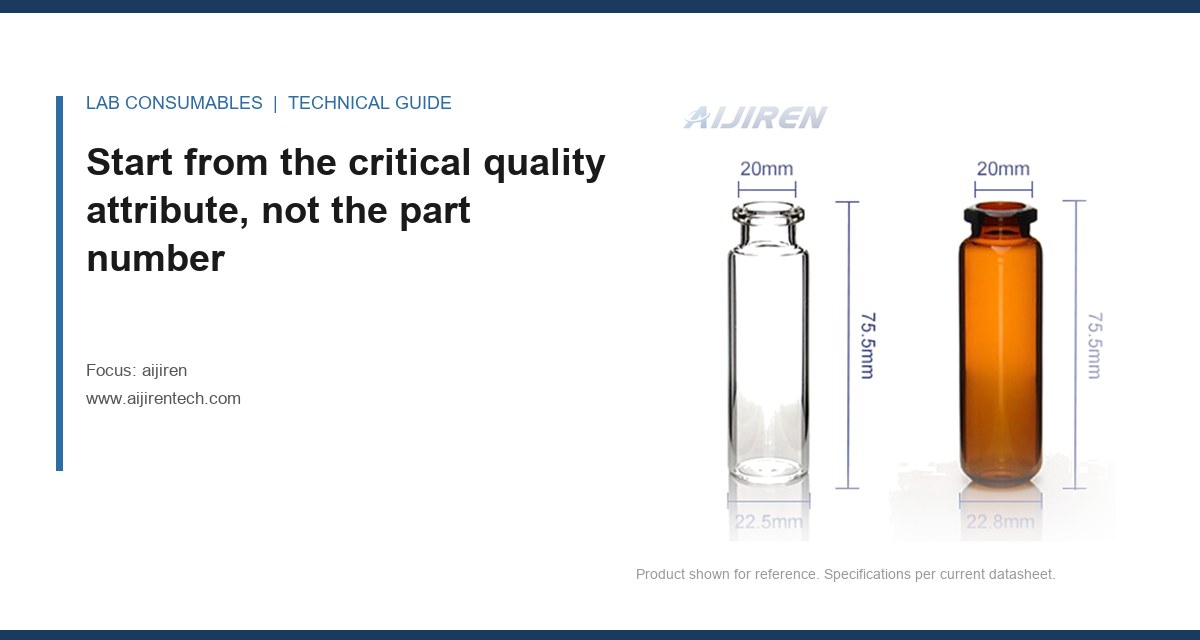
Lot 22-0417 of 9 mm screw-thread vials, clear glass, 32 x 11.6 mm, came in from a supplier we had used for four years. The certificate said the same thing it always said. The first injection sequence on the GC-FID method for residual solvents gave an internal standard area RSD of 11.4% across six replicates, against a method limit of 5.0%. Nothing in the instrument had changed. The septa had changed: the new lot was a different silicone compound from a different molding line, and the same needle was coring them at a different rate. We had a revalidation trigger whether we wanted one or not. The question was how to write it up so that an auditor reading the change-control file six months later would accept the reasoning rather than ask why we had not revalidated.
That question is the whole subject of this article: which supplier or lot changes force revalidation, which only need verification, and how to record the decision. If you buy consumables from Aijiren or from any other source, you will hit this. The answer is not “revalidate everything” and it is not “verify everything.” It is a documented decision tree with a defensible rationale at each branch.
Most change-control failures I have seen begin with a form that asks “has the supplier changed?” and a buyer who answers “no” because the part number is the same. That is the wrong question. The right question is whether any critical quality attribute (CQA) of the consumable in contact with the sample has changed, and whether that attribute is on the method’s critical path.
For a vial and cap assembly, the CQAs that matter to a validated method are a short list:
- Glass composition and hydrolytic class (USP Type I borosilicate, ISO 4802 hydrolytic resistance). A change from Type I to Type II, or a change in the boron oxide content, changes the extractables profile.
- Septum compound and cure. Silicone formulation, platinum catalyst level, post-cure time. Each changes both the volatile extractables and the reseal behavior after puncture.
- Septum thickness and durometer. A 1.0 mm septum at 50 Shore A behaves differently from a 1.3 mm septum at 45 Shore A under the same needle.
- Liner film (PTFE, PTFE/silicone laminate, foil). Film thickness and the bonding method decide whether the liner delaminates under the needle.
- Crimp geometry for crimp-top formats. Crimp height and the resulting seal compression.
- Cleanliness, expressed as a validated extractables test, not a visual inspection.
If a supplier change touches none of these, you have a verification case, not a revalidation case. If it touches any of them on the critical path of a validated method, you have a revalidation trigger. The rest is bookkeeping.
The change categories and what each one actually demands
I use four categories in our change-control SOP. Each maps to a defined level of work. The category is assigned by the QA reviewer, not the buyer, and it is assigned before the new material is released to production.
Category 1: administrative change, verification only
Supplier name change with no change to the manufacturing site or the drawings. Distributor change. Packaging carton change with the same inner pack. Certificate format change. These need a verification: incoming inspection per the existing sampling plan, dimensional check on the first lot, and a note in the change record. No analytical work. No revalidation.
Category 2: same specification, different manufacturing site or line
This is the category people get wrong most often. The drawing is identical; the site is not. A different molding line means a different mold, a different cooling profile, potentially a different glass tubing source. Verification here means a full dimensional and functional lot release plus a system suitability run on the affected method: six injections of the system suitability solution, check the tailing factor, the resolution, and the internal standard area RSD against the method limits. If system suitability passes on the first lot, you have evidence the change did not perturb the method. That is verification, and it is defensible.
Category 3: specification change to a CQA
New septum compound. New liner film. New glass class. This is a revalidation trigger for every validated method that uses the part, unless you can demonstrate by risk assessment that the changed attribute is not on that method’s critical path. Demonstration means data, not an opinion. For a septum compound change on a headspace method, the data is a comparative extractables study and a re-run of the method’s accuracy and precision at the low end of the calibration range.
Category 4: unexplained failure or drift
No change was notified, but the method started failing system suitability on a new lot. This is Category 4 and it is treated as a revalidation trigger until proven otherwise. The investigation either finds a root cause that is not the consumable (and closes as such) or confirms the consumable as the cause (and triggers revalidation of the affected method).
Where verification ends and revalidation begins
The line between the two is not a matter of taste. It is a matter of what the method’s validation package actually claims. A method is validated for a defined set of performance characteristics: specificity, linearity, accuracy, precision, range, LOD/LOQ, robustness. A consumable change that could plausibly move any of those characteristics outside its acceptance criteria requires revalidation of that characteristic. A change that cannot plausibly move any of them requires only verification.
In practice, for vial and cap changes, the characteristics at risk are narrow:
- Specificity is at risk when the septum or liner extractables profile changes, because new peaks can co-elute with analytes of interest.
- Precision (repeatability) is at risk when the reseal behavior or the crimp seal changes, because injection-to-injection volume or headspace composition can shift.
- Accuracy at the low end is at risk when adsorption to the glass surface changes (silanization, glass class).
- Robustness is at risk when the puncture count to failure changes, because longer sequences see more coring.
Linearity, range, and LOD/LOQ rarely move with a consumable change unless the change is severe. I do not revalidate them for a Category 2 change. I do for a Category 3 change that alters extractables, because a shifted baseline can move the LOD.
A decision checklist you can paste into the SOP
| Change observed | Category | Minimum work | Acceptance evidence |
|---|---|---|---|
| Distributor or carton change, same site and drawing | 1 | Incoming inspection, dimensional check | Lot release record |
| Same drawing, new molding line or site | 2 | Full lot release plus system suitability, n=6 | IS area RSD ≤ method limit (typically 5.0%), tailing ≤ 2.0 |
| Septum compound or durometer change | 3 | Comparative extractables plus precision and accuracy at LOQ | No new peaks > LOQ in blank; recovery 90-110% at LOQ |
| Liner film or bonding change | 3 | Extractables plus puncture-reseal test | No delamination at 3 punctures; seal holds 1.0 bar for 60 s |
| Glass class change (Type I to II or equivalent) | 3 | Extractables plus adsorption check at LOQ | Recovery 85-115% at LOQ for polar analytes |
| Unexplained system suitability failure on new lot | 4 | Root-cause investigation, then revalidation if consumable confirmed | Investigation report plus revalidation package |
The numbers in the acceptance column are the ones we use; yours come from your own validation package. The point is that each row has a number attached, and the number is traceable to the method.
How to write the change-control entry so an inspector accepts it
An inspector reading a change-control entry is not checking whether you did a lot of work. They are checking whether your reasoning is traceable from the change to the decision. I have seen entries rejected for being too thin (“Supplier changed septum; verified by incoming inspection; no impact”) and for being too thick (a forty-page revalidation package with no statement of why revalidation was chosen). The entry that passes has five parts, in this order.
1. The change, stated as an attribute, not an event
Not “supplier changed septum.” Write: “Septum compound changed from a platinum-cured silicone (50 Shore A, 1.0 mm) to a platinum-cured silicone (45 Shore A, 1.3 mm) from a different molding line. Supplier notified 2024-03-11. Affected part numbers: 5183-4757 equivalent, 9 mm screw thread.” The attribute is what the reviewer assesses. The event is what the buyer saw.
2. The risk assessment, with the critical path named
List the validated methods that use the part, and for each, state whether the changed attribute is on the critical path. “Method RES-SOLV-014 (GC-FID, residual solvents): septum durometer is on the critical path because needle coring at >3 punctures per vial produces silicone fragments that elute in the 8-12 min window. Method ASSAY-022 (HPLC): septum is not on the critical path because the autosampler uses a pre-slit septum and punctures once per vial.” That sentence does more work than a page of narrative.
3. The decision, with the category and the work assigned
“Category 3 for RES-SOLV-014. Work assigned: comparative extractables (blank injection series, n=6), precision at LOQ (n=6), accuracy at LOQ (n=3 levels). Category 2 for ASSAY-022. Work assigned: system suitability n=6 on first lot.” The category is the decision. The work is the consequence.
4. The data, with the acceptance criteria restated
Do not just attach the chromatograms. Restate the acceptance criterion next to the result. “IS area RSD: 3.1% against limit 5.0%. Pass.” “Blank injection: no peak > LOQ in the 8-12 min window. Pass.” “Recovery at LOQ: 96.4%, 101.2%, 94.8% against 90-110%. Pass.” If a criterion fails, the entry does not close; it escalates.
5. The conclusion, stated as a release decision
“RES-SOLV-014 revalidated for the new septum compound. Method remains in validated state. New lot released for production use. Next review: on next supplier change notification or 12 months, whichever is sooner.” That last sentence is what an inspector wants to see, because it shows the change was closed with a defined re-entry point.
One more thing. The entry needs a signature from QA, not just from the lab. A change-control entry signed only by the analyst reads as a lab decision that QA tolerated. A change-control entry signed by QA reads as a quality system decision. The difference matters when the inspector asks who approved the category assignment.
Two field cases where the category was misassigned
Case 1: the Category 2 that was actually a Category 3
A supplier moved production of a 2 mL clear glass vial from one plant to another and notified us as a site change. We assigned Category 2 and ran system suitability on the first lot. It passed. Six weeks later, an HPLC method for a low-level impurity started showing a recovery of 82% at the 0.05% level against a limit of 85-115%. The site change had come with a change in glass tubing supplier, which changed the surface silanol activity, which increased adsorption of the basic analyte at low concentration. The notification said “site change.” The reality was a glass surface change, which is a Category 3 attribute.
The fix was a revalidation of the accuracy characteristic at the LOQ, plus a switch to a silanized vial for that method. The lesson is that a site change notification is not a specification statement. Ask for the glass tubing source and the hydrolytic resistance data on any site change, and if either has moved, treat it as Category 3.
Case 2: the Category 4 that was not the consumable
A headspace method for a volatile analyte failed system suitability on a new lot of crimp-top vials: the internal standard area dropped 18% between the first and sixth injection of the same vial. The obvious read was septum leakage. We assigned Category 4 and started the investigation. The measurement that identified the real cause was a crimp-height check with a crimper gauge: the new lot’s caps crimped to 5.9 mm against a target of 5.5 mm on the old lot, because the new caps had a 0.4 mm thicker skirt. The seal was not compressing. The consumable had changed, but the changed attribute was the cap skirt thickness, not the septum. The fix was a crimper adjustment and a re-run, and the method closed as a Category 2 verification with a crimp-height specification added to incoming inspection. The revalidation was avoided, but only because the measurement was taken before the revalidation was booked.
Both cases point the same way: the category assignment is only as good as the attribute data behind it. If you cannot state which attribute changed and by how much, you cannot assign a category. You can only guess, and a guess in a change-control file is what an auditor writes a finding about. Suppliers who can give you the attribute-level data on request, and who publish the molding and tubing sources behind a part number, make this tractable. That is one of the practical reasons to buy from a supplier who holds the drawings rather than a distributor who holds the cartons, a point covered at Vial Supplier.
The specific numbers that belong in the specification
If your incoming specification for a vial and cap assembly does not carry numbers on the attributes below, your change-control decisions have nothing to stand on. These are the ones I put in the spec sheet for a 9 mm screw-thread assembly used on a validated GC or HPLC method:
- Glass: USP Type I borosilicate, hydrolytic resistance per ISO 4802-1, with the lot’s titration result recorded.
- Dimensions: 32.0 x 11.6 mm body, neck OD 9.0 mm, GPI 9 mm thread per the Glass Packaging Institute standard. Tolerance ±0.2 mm on body OD, ±0.3 mm on height.
- Septum: silicone, 1.0 mm ±0.1 mm thickness, 45-55 Shore A durometer, pre-slit or not as specified. Reseal after 3 punctures with a 23-gauge needle at 1.0 bar for 60 s, no leak.
- Liner: PTFE film, 0.1 mm ±0.02 mm, bonded, no delamination at 3 punctures.
- Crimp (crimp-top only): cap skirt height 5.5 mm ±0.1 mm, crimp height 5.5 mm ±0.1 mm after crimping, seal compression 20-30%.
- Cleanliness: extractables by the method’s own blank injection series, no peak > LOQ in the analyte window.
- Puncture count to failure: recorded per lot, minimum 3 for a single-use autosampler vial, minimum 10 for a multi-injection vial.
When a supplier change touches any of these numbers, you have a documented basis for assigning a category. When it touches none of them, you have a documented basis for verification. Either way, the entry writes itself.
What to ask the supplier, and what to do with the answer
The supplier notification is the input to the whole process, and most notifications are too thin to assign a category. I ask four questions on every change notice, in writing, and I keep the answers in the change file:
- Which manufacturing site and which molding line? (A site change with the same line is Category 2. A line change is Category 2 with a dimensional focus.)
- Which incoming material changed: glass tubing source, septum compound, liner film, cap resin? (Any of these is Category 3.)
- What are the attribute values on the new material, with the test method? (If the supplier cannot give you a durometer and a thickness, you cannot assign a category.)
- What is the first lot number affected, and is there a retained sample of the prior lot? (The retained sample is what makes a comparative extractables study possible.)
The answers are the evidence base. A supplier who answers all four is a supplier you can do change control with. A supplier who answers none is a supplier whose every lot is a Category 4 until proven otherwise, which is an expensive way to buy glass. The chromatographic side of this, including the system suitability limits and the blank-injection acceptance criteria, is covered in more depth at Lab Chromatography, and the regulatory frame for waste and materials methods sits in the U.S. EPA SW-846 test methods. For the instrument-side consumables that pair with these vials, the vendor technical libraries at Agilent, Thermo Fisher, and Restek carry the system suitability and bleed data you will need to set the acceptance criteria.
Revalidation triggers when the lot, not the supplier, changes
The harder case is the one I opened with: no supplier notification at all, but a lot that behaves differently. This is a Category 4 by default, and the investigation has a defined shape. First, confirm the failure is lot-associated by running the same method on a retained sample of the prior lot under the same conditions. If the prior lot passes and the new lot fails, the lot is implicated. Second, isolate the attribute: dimensional check, durometer check, crimp-height check, extractables blank. Third, compare against the specification. If the attribute is out of spec, you have a supplier nonconformance and a Category 3 change. If the attribute is in spec but different from the prior lot, you have a within-spec drift, which is the most common and the most annoying outcome.
Within-spec drift is where the decision rule earns its keep. A within-spec drift on an attribute that is on the method’s critical path is a revalidation trigger even though nothing is out of specification. A within-spec drift on an attribute that is not on the critical path is a verification. The distinction is the critical path, not the specification limit. That is the sentence to put in the SOP.
The decision rule
Assign every supplier or lot change to one of the four categories before the material reaches production, and let the category set the work. Category 1 and 2 are verification: incoming inspection plus a system suitability run with the numbers restated against the method limits. Category 3 is revalidation of the specific performance characteristics the changed attribute can move, not the whole method. Category 4 is an investigation that resolves to one of the other three. Write the entry with five parts (attribute, critical path, category, data against criteria, release decision), sign it in QA, and add a crimp-height and durometer check to incoming inspection so the next lot drift is a measurement rather than a surprise. The revalidation triggers when a supplier or lot changes are not a matter of judgment once the critical path is written down; they are a lookup.
References & further reading
Related resources from our lab consumables network:
- Aijiren at aijirentech.com
- Vials With Caps at vialswithcaps.com
- Vial Supplier at vialsupplier.com
- Lab Chromatography at labchromatography.com
External references and standards: